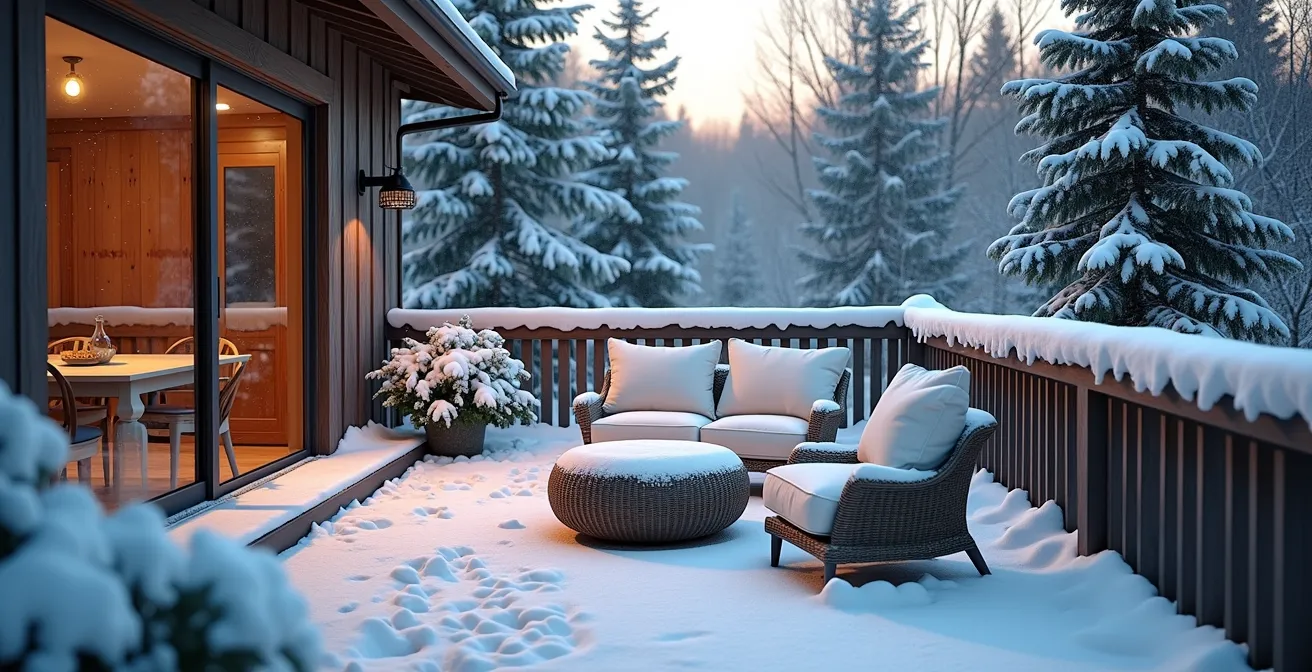
The secret to winter-proof patio furniture isn’t better covers; it’s selecting materials and designs that are fundamentally engineered to manage moisture and withstand the freeze-thaw cycle.
- Material integrity is paramount. Cast aluminum and HDPE plastic offer superior longevity over untreated steel or low-quality wicker.
- Moisture is the true enemy. Proper drainage within furniture frames and cushion systems is more critical than simple surface waterproofing.
Recommendation: Stop buying furniture you need to rescue. Start investing in “perennial” pieces designed from the ground up to be left outside, saving you money and frustration in the long run.
The annual ritual is a familiar one for many homeowners: hauling cushions into a packed garage, wrestling with unwieldy covers, and hoping for the best as winter descends. Come spring, the unveiling often brings disappointment—a fresh bloom of rust on a chair leg, a split in a wooden armrest, or mildewed cushions that are beyond saving. You’re left with the frustrating task of cleaning, repairing, or worse, replacing items you bought only a couple of years ago. The common advice revolves around protection: better covers, more diligent storage, and seasonal maintenance.
But what if this entire approach is flawed? What if the problem isn’t how you protect your furniture, but the furniture you chose in the first place? The endless cycle of replacement is often driven by impulse buys fueled by the stress of a bare patio, leading to choices based on immediate aesthetics rather than long-term material science. True durability isn’t an afterthought or a feature you add with a cover; it’s engineered into the very core of a piece. It’s about understanding the physics of failure—how water freezes and expands, how UV rays degrade plastics, and how wind applies force.
This guide reframes the selection process. We will move beyond superficial “weather-resistance” and delve into the principles of material integrity and structural design. By adopting the mindset of a “perennial gardener”—choosing things designed to return stronger year after year—you can select patio furniture that you can genuinely set and forget. We’ll analyze the common failure points of popular materials, explore the critical role of hidden design features like drainage, and give you the framework to make an investment that pays dividends in longevity and peace of mind.
To navigate this expert-led approach, the following sections break down the key considerations, from material science to the psychology of purchasing, ensuring your next outdoor furniture set is your last for a very long time.
Summary: A Material-First Guide to Indestructible Patio Furniture
- Why Your Teak Furniture Changes Color and How to Maintain It?
- How to Waterproof Your Outdoor Cushions for Penny?
- Cast Aluminum or Resin Wicker: Which Lasts Longer in Direct Sun?
- The Mistake of Buying Lightweight Furniture for Windy Balconies
- How to Arrange Patio Seating to Encourage Conversation?
- Why You Shop More When You Are Stressed or Tired?
- Why Ignoring Drainage Will Ruin Your Expensive Landscaping?
- How to Design a “Set It and Forget It” Perennial Garden?
Why Your Teak Furniture Changes Color and How to Maintain It?
One of the most common points of confusion for owners of high-end furniture surrounds teak. Many invest in this tropical hardwood for its legendary durability, only to watch its warm, honey-brown color fade to a silvery-gray patina within a single season. This is not a sign of decay; it’s a natural chemical process. The sun’s UV rays break down the natural oils and pigments on the surface of the wood. The resulting gray layer is actually a form of natural protection, shielding the structurally sound wood underneath. Embracing this patina is the lowest-maintenance approach.
However, if your goal is to preserve the original honey-brown color through winter, your strategy must shift from passive acceptance to active preservation. This involves creating a barrier against UV and moisture *before* the color change occurs. The key is applying a specialized sealer, but not all sealants are created equal, especially when facing freezing temperatures. The wrong choice can trap moisture, leading to cracking and black spots—a far worse outcome than the distinguished silver patina.
Understanding the performance differences between sealant types is crucial for winter survival. Penetrating oils offer a natural look but require frequent reapplication, while heavy varnishes can form a film that cracks in the cold. A two-part marine varnish offers the best protection but fundamentally alters the wood’s appearance and is difficult to remove later.
| Sealant Type | Winter Performance | Pros | Cons | Reapplication Frequency |
|---|---|---|---|---|
| Penetrating Oils | Good | Deep penetration, maintains natural look | Requires frequent reapplication | Every 3-4 months |
| Film-Forming Sealants | Poor | Initial waterproofing | Can crack in cold, trap moisture | Annually (but not recommended) |
| Two-Part Marine Varnishes | Excellent | Superior protection, UV resistant | Changes wood appearance, difficult removal | Every 1-2 years |
Ultimately, maintaining teak is a choice between embracing its natural, low-effort aging process or committing to a rigorous, material-specific maintenance schedule to preserve its original color. The worst approach is neglect combined with a desire for color retention, which leads to irreversible damage.
How to Waterproof Your Outdoor Cushions for Penny?
The phrase “waterproofing cushions” is a common but misleading goal. For a homeowner tired of dealing with soggy, mildewed seating, the ambition should not be to create an impermeable barrier, but to design a system for rapid moisture management. A truly waterproof cover can trap condensation and ambient humidity inside, creating the perfect environment for mold and rot. The expert approach focuses on repelling the bulk of water while allowing the cushion to breathe and dry out quickly.
The most effective and budget-friendly strategy begins with the fabric itself. Most quality outdoor cushions use synthetic fabrics like Olefin or solution-dyed acrylics, which are inherently resistant to moisture and mildew. The first line of defense is a simple water-repellent spray designed for outdoor fabrics. Applied correctly, these sprays cause water to bead up and roll off, as shown in the image below, rather than soaking in. Reapplying this coating at the start of each season is a small investment that dramatically extends a cushion’s life.

This surface treatment is only part of the solution. A successful “Cushion Survival System” also addresses airflow and drainage. One homeowner achieved a 95% reduction in moisture damage by thinking systemically. They used mesh fabric on the cushion bottoms to allow drainage, placed deck tiles under the seating to create an air gap for circulation, and then applied a repellent spray. This combination approach ensures that any moisture that does penetrate can escape quickly, preventing the saturation that leads to material breakdown and, as one expert notes, can make brand-new furniture look 10 years old in just one season.
Cast Aluminum or Resin Wicker: Which Lasts Longer in Direct Sun?
When choosing furniture that must endure the elements, the debate between cast aluminum and resin wicker is central. Both are often marketed as “all-weather,” but their long-term performance, especially in direct sun and winter conditions, varies significantly due to their fundamental material properties. The choice hinges on understanding their distinct failure modes.
Cast aluminum’s primary advantage is its inherent material integrity. As a solid metal, it does not absorb water, making it impervious to the internal damage caused by the freeze-thaw cycle. Its powder-coated finish provides the first line of defense against oxidation and UV rays. When this coating is inevitably scratched or chipped, the exposed aluminum forms a hard, cloudy oxide layer that protects the metal from further corrosion. This is why aluminum is ideal for colder climates with rain, snow and ice. It will not rust in the way steel does, making it a true “set it and forget it” frame material. Its weakness is primarily aesthetic—the finish can fade or chip over many years, but the structural integrity remains intact.
Resin wicker, on the other hand, is a synthetic material, typically HDPE (High-Density Polyethylene), woven over a metal frame. The quality of both the wicker strands and the hidden frame is critical. High-quality, UV-stabilized HDPE can last for years in direct sun without fading or becoming brittle. However, low-quality PVC or non-stabilized polyethylene will quickly degrade under UV exposure, leading to cracking and unraveling. More importantly, the frame beneath is the true point of failure. If the manufacturer used cheap, powder-coated steel instead of aluminum, a single scratch in the finish will allow water to penetrate, leading to rust that expands and breaks the wicker from within.
For longevity in a four-season climate, cast aluminum is unequivocally the more durable choice. Its failure mode is gradual and cosmetic, not catastrophic and structural. With resin wicker, you are placing your trust in the hidden quality of two separate components, where the failure of one (the frame) destroys the whole piece.
The Mistake of Buying Lightweight Furniture for Windy Balconies
In the quest for durable outdoor furniture, homeowners often focus exclusively on material resistance to rain and sun, completely overlooking a powerful and destructive force: wind. On exposed patios, rooftops, and especially balconies, the weight of your furniture is not a bug, but a critical safety and durability feature. The common mistake is purchasing lightweight aluminum or plastic chairs for their convenience and modern aesthetic, only to find them tossed around or thrown completely off the balcony during a storm.
The physics of this is simple. Wind flowing over and around furniture creates pressure differences, resulting in aerodynamic lift—the same principle that allows an airplane to fly. A lightweight, broad-backed chair acts like a sail, catching the wind and becoming airborne. This not only destroys the furniture but also poses a significant danger to property and people below. Relying on furniture covers in this scenario can even exacerbate the problem, as they increase the surface area and act as a parachute, catching more wind.
The most effective solution is to choose furniture with significant mass. Wrought iron is the undisputed champion in this regard. With individual pieces often weighing 50 to 100 pounds, they possess enough sheer inertia to resist all but the most extreme winds. A homeowner in a high-wind coastal area reported zero wind damage over five winters by choosing heavy wrought iron, demonstrating that mass is the ultimate defense. The trade-off is obvious: this furniture is extremely difficult to move and store.
If heavy wrought iron isn’t practical or desirable, the strategy must shift to increasing the stability of lighter pieces. This can be achieved by connecting furniture pieces together with specialized connectors to form a single, heavier mass. Other tactics include using discreet, decorative sandbags on chair or table bases, or anchoring furniture to heavier items like large planters using high-tensile strength tethers for the winter season.
How to Arrange Patio Seating to Encourage Conversation?
While arranging seating for conversation is a key part of enjoying your patio in the summer, the question for winter survival is different: how do you arrange furniture to protect itself? A strategic “hibernation arrangement” is not about aesthetics but about creating a defensive cluster that minimizes exposure to winter’s worst hazards. This practical approach ensures that when spring arrives, your furniture is ready for conversational groupings, not the scrap heap.
The first principle of a winter arrangement is elevation and drainage. Group your furniture on the highest and best-draining part of your patio. This prevents water from pooling around the feet and legs, where the freeze-thaw cycle can cause cracks, split welds, or accelerate corrosion. The second principle is sheltering. Identify the areas of your patio that are most protected from prevailing winds and falling hazards. Positioning furniture against a solid wall is far better than leaving it exposed in the center. Crucially, pay attention to your roofline and avoid placing your clustered items directly under eaves where heavy snow or large icicles can fall and cause impact damage.
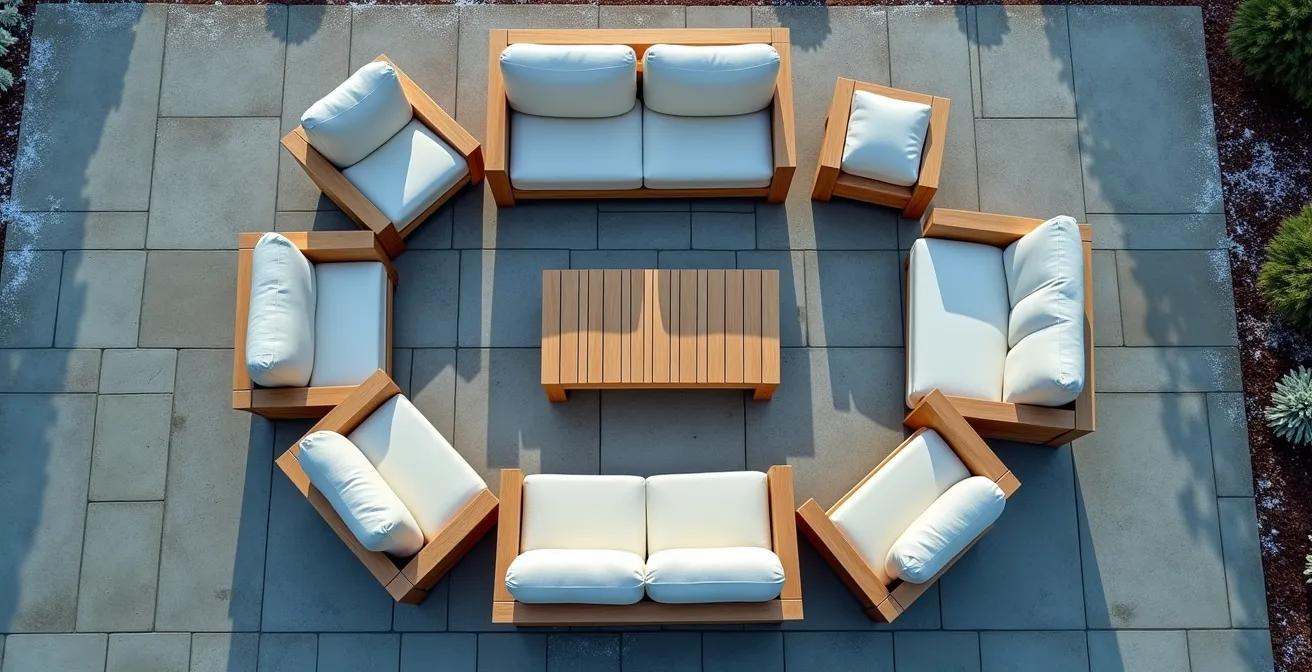
Once you’ve chosen a location, the arrangement should prioritize density and airflow. Stacking chairs (if designed to do so) and sliding them under tables creates a compact, solid mass that is more resistant to wind and easier to cover efficiently. When using covers, it’s vital to ensure they don’t lie flat on tabletops or create pockets where water can pool and freeze. Use a bucket or large ball in the center of a table to create a “tent” effect, so water runs off. Finally, even under a cover, airflow is essential to prevent mold. Arrange the covered bundle to allow air to circulate underneath, perhaps by placing it on blocks or pallets.
A smart winter arrangement is a proactive defense. By thinking about drainage, shelter, and density, you transform your collection of individual pieces into a single, resilient unit, ensuring they are pristine and ready for those future conversations.
Why You Shop More When You Are Stressed or Tired?
The cycle of replacing patio furniture every few years is not just a financial or practical problem; it’s often a psychological one. Understanding the behavioral trap you might be falling into is the first step to breaking it. The primary culprit is the stress and decision fatigue associated with making a significant purchase. When your old furniture fails after a harsh winter, you are faced with an empty, unusable patio just as the warm weather begins. This creates a sense of urgency and stress.
This pressure leads to impulsive decisions. Instead of conducting thorough research into material science and long-term durability, you are more likely to make a quick purchase based on what is readily available, on sale, or aesthetically pleasing at first glance. You are solving an immediate emotional problem (the desire to use your patio *now*) rather than a long-term engineering problem (selecting furniture that will last). As home insurance expert Divya Sangameshwar notes, this creates a damaging loop.
The stress of an empty patio in spring leads to impulsive, cheap purchases, which causes the winter-survival stress you’re trying to solve now.
– Divya Sangameshwar, ValuePenguin Home Insurance Expert
This cycle of buying cheap, inadequate furniture is an expensive one. The initial savings are quickly erased by the need for repeated replacements. The financial stakes are not trivial; poor preparation for winter weather can have massive consequences. For context, an analysis of NOAA data revealed that winter weather events can cause staggering financial losses, highlighting the importance of protecting your outdoor investments from the start. Ignoring the long-term view in favor of a short-term fix is a costly error driven by a predictable psychological response. The solution is to do your research off-season, when there is no pressure, and to treat the purchase as a long-term investment in your home’s infrastructure.
Why Ignoring Drainage Will Ruin Your Expensive Landscaping?
In landscaping, every expert knows that ignoring drainage is a recipe for disaster. Standing water suffocates roots, erodes soil, and can damage foundations. The exact same principle applies to the expensive furniture you place *on* that landscape, but with an even more aggressive agent of destruction: the freeze-thaw cycle. This is the single most potent, and most frequently ignored, threat to the structural integrity of outdoor furniture.
The mechanism is simple but relentless. Most metal furniture is constructed from hollow tubes. If these tubes lack “weep holes” or drainage channels, rainwater and condensation can accumulate inside. When the temperature drops below freezing, this trapped water turns to ice. As water freezes, it expands by approximately 9% with immense force—enough to split steel or burst aluminum welds from the inside out. This damage is often invisible until a leg suddenly collapses or a frame cracks in the spring. It is a catastrophic structural failure caused by a tiny, overlooked design flaw.
Case Study: The POLYWOOD Drainage Revolution
Manufacturers at POLYWOOD discovered this exact issue was causing widespread frame failures. Their aluminum frames, though rust-proof, were trapping water that would freeze, expand, and split the metal. Their solution was brilliantly simple: they engineered visible drainage holes at strategic, low points in the frames. This “ground-up” protection approach, combined with using adjustable feet to lift pieces slightly off the ground, ensures water can always escape. This change led to a reported 90% reduction in frame failures and has become a standard for truly winter-resistant design.
Protecting your investment requires you to become a drainage inspector. Before buying any piece of hollow-frame furniture, turn it over and look for these small but critical weep holes. If you already own furniture, you can take proactive steps to improve its drainage and prevent internal damage before it’s too late.
Your 3-Point Drainage Audit for Furniture Survival
- Check for weep holes: Before winter, inspect all hollow metal frames for existing weep holes and ensure they are clear of debris.
- Elevate your furniture: Install adjustable risers or small plastic feet to lift all pieces 1-2 inches off the ground, preventing them from sitting in puddles or ice.
- Use the slope: Position your furniture on sloped surfaces of your patio or add subtle shims under legs to ensure water actively runs away from, not toward, the furniture’s base.
Key Takeaways
- The goal is not just “waterproofing,” but holistic “moisture management” through drainage, airflow, and material choice.
- Weight is a feature, not a flaw. In windy locations, heavy materials like wrought iron or solid cast aluminum prevent dangerous and costly damage.
- The freeze-thaw cycle is the silent killer. Ensure any hollow-frame furniture has adequate drainage holes to prevent internal bursting.
How to Design a “Set It and Forget It” Perennial Garden?
The philosophy behind a successful perennial garden offers the perfect metaphor for selecting durable outdoor furniture. A perennial gardener doesn’t plant with the expectation of starting over from scratch each spring. They choose plants based on their climate zone, soil type, and sun exposure, selecting species that are inherently suited to thrive in that specific environment. They invest time upfront to create a self-sustaining ecosystem that returns year after year with minimal intervention. You must adopt this same mindset.
Stop thinking of your patio furniture as a disposable seasonal accessory. Start thinking of it as a permanent part of your home’s exterior infrastructure. This means choosing materials based on your “climate zone”—your specific environmental challenges, be they intense sun, heavy snow, salt air, or high winds. Just as a gardener wouldn’t plant a tropical hibiscus in a cold climate, you shouldn’t choose unprotected steel for a coastal patio. The market for outdoor furniture is booming, with one forecast showing a growth from a $56.00 billion market value in 2025 to $81.44 billion by 2032, demonstrating a clear trend toward higher-quality, longer-lasting investments.
To apply this “perennial” philosophy, you can classify furniture into categories based on their maintenance needs and survival rates, much like a gardener classifies plants. This framework shifts the focus from initial price to lifetime value and owner effort.
| Material Category | Owner Type | Maintenance Level | Winter Survival Rate | Market Share 2024 |
|---|---|---|---|---|
| HDPE/Cast Aluminum | Set It and Forget It | Minimal | 95%+ | Growing 5.5% CAGR |
| Teak/Ipe Hardwood | Active Gardener | Seasonal care required | 85-90% | 34.96% (wood overall) |
| Wrought Iron | Heritage Keeper | Annual rust prevention | 80% | Declining |
| Basic Plastic/PVC | Budget Conscious | Replace frequently | 50-60% | Stable |
By adopting this framework, you are no longer just a shopper; you are a landscape designer for your outdoor space. You are making a conscious, informed decision to invest in pieces that are engineered to endure, freeing you from the costly and frustrating annual cycle of replacement.
Now that you are armed with an engineer’s perspective, the next logical step is to audit your own outdoor space and existing furniture. Assess your specific climate challenges and evaluate which materials and designs are truly built to last in your environment, ensuring your next purchase is a final one.