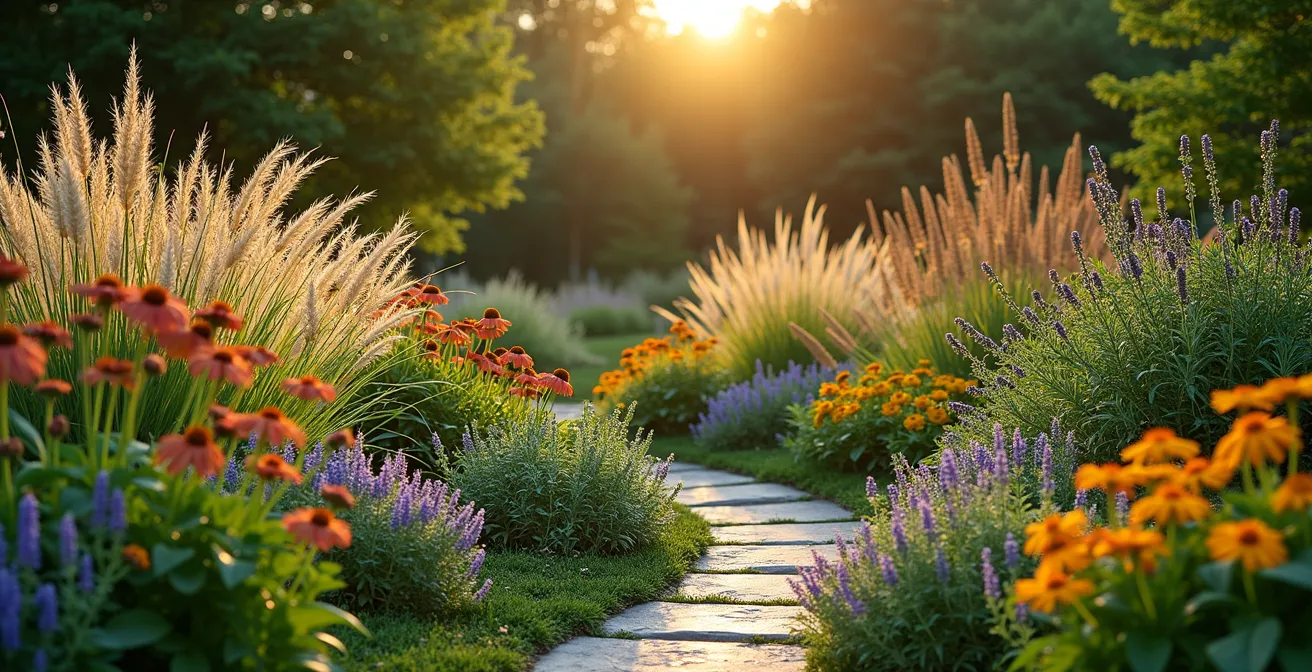
A true “set and forget” garden isn’t about finding indestructible plants, but designing a smart ecosystem that manages itself.
- Mastering plant behavior (aggressive spreaders vs. polite clumpers) prevents future garden wars and endless maintenance.
- Layering bulbs and perennials by bloom time and foliage texture creates continuous color and structure without constant replanting.
Recommendation: Audit your yard’s long-term maintenance costs and time investment before planting a single flower to make the most cost-effective, low-effort choice.
For the busy homeowner, the dream is simple: a garden that explodes with color and life, not a second job that demands constant weeding, watering, and replanting. The promise of a “set it and forget it” perennial garden seems like the perfect solution. You plant once, and nature does the rest. Yet, many who try this find their beautiful May display descends into a tangled, flowerless mess by August, leaving them more frustrated than when they started.
The conventional wisdom isn’t wrong, just incomplete. You’ve heard it all: “pick perennials,” “use mulch to stop weeds,” and “choose drought-tolerant plants.” These are foundational steps, but they are merely ingredients. They don’t provide the recipe for a garden that is truly self-sustaining. The real challenge goes beyond simple plant selection and touches on adjacent concepts like hardscaping with pavers or deciding whether a lawn is worth the upkeep at all.
But what if the secret wasn’t just *what* you plant, but *how* you design the entire system from the ground up? What if “forgetting” your garden was the result of smart, upfront decisions about plant behavior, strategic layering, and, most importantly, a clear understanding of what *not* to plant? This is the shift from a gardener who works *for* their plants to a designer who makes plants work *for them*.
This guide provides the blueprint for that shift. We will walk you through the strategic principles of creating a truly low-maintenance garden ecosystem. You will learn how to design for year-round appeal, leverage plant division for free expansion, avoid common planting mistakes that lead to chaos, and ultimately create a landscape that boosts your curb appeal and gives you back your weekends.
Summary: Your Blueprint for a Truly Low-Maintenance Perennial Garden
- Why Your Garden Looks Dead in August and How to Fix It?
- How to Divide Hostas to Get Free Plants for Your Yard?
- Bulbs or Rhizomes: Which Spreads Faster to Fill Space?
- The Mint Mistake: Perennials You Should Never Plant in the Ground
- When to Plant Tulips Before the Ground Freezes?
- Why Native Plants Survive Heat Waves Better Than Imports?
- Pavers or Grass: Which Costs Less to Maintain Over 10 Years?
- How to Landscape Your Front Yard to Boost Curb Appeal by 10%?
Why Your Garden Looks Dead in August and How to Fix It?
One of the biggest frustrations for new perennial gardeners is the “August Slump.” The garden, vibrant with irises, peonies, and poppies in late spring, suddenly looks tired, green, and flowerless by late summer. This happens because many popular perennials have a front-loaded bloom cycle. The key to a true “set it and forget it” garden is planning for a succession of interest that carries through all seasons, not just the peak of spring. This requires thinking beyond flowers and embracing a three-layer system of planting.
First, intentionally select late-season bloomers. These are the workhorses that kick into gear when others are fading. Plants like Asters, Sedum ‘Autumn Joy’, and various ornamental grasses provide essential color and movement from August through October. They bridge the gap between summer’s end and the first frost, ensuring your garden never has an “off” month.
Second, integrate plants prized for their foliage and lasting texture. Flowers are fleeting, but leaves provide structure for months. Heuchera (Coral Bells) offers a rainbow of leaf colors from deep burgundy to lime green, while Hostas provide bold, architectural forms in shady spots. This textural backbone, the “perennial matrix,” makes the garden look full and intentional even when nothing is in bloom. Finally, practice strategic neglect. Instead of deadheading every spent flower, leave the structural seed heads of plants like Echinacea (Coneflower) and Rudbeckia (Black-eyed Susan) standing. They add sculptural interest against the winter snow and provide a vital food source for birds, turning your garden into a year-round ecological asset.
How to Divide Hostas to Get Free Plants for Your Yard?
A “set and forget it” garden doesn’t mean a static garden. A well-designed perennial system grows and matures, offering a fantastic return on investment: free plants. Division is the simple process of digging up a mature perennial clump, splitting it into smaller sections, and replanting them. This not only populates other areas of your garden for free but also reinvigorates many perennials, encouraging more vigorous growth and better flowering. For plants like Hostas, Daylilies, and Astilbe, division every 3-5 years is a healthy practice that keeps the plant from becoming overcrowded and unproductive.
The timing of division is crucial for minimizing stress on the plant. The general rule is to divide based on bloom time: divide spring-blooming perennials after they finish flowering in late spring or early summer, and divide summer and fall-blooming perennials in the early spring as new growth emerges. This gives the new divisions a full season to establish their root systems before facing the stress of heat or cold. To divide a plant like a Hosta, simply lift the entire clump out of the ground with a garden fork. You can then use a sharp spade or a soil knife to slice the clump into sections, ensuring each new piece has a healthy portion of both roots and “eyes” (the growing points).
However, not all perennials want or need to be divided. Part of a low-maintenance strategy is knowing what to leave alone. Plants with a single, deep taproot, such as Baptisia (False Indigo) and Peonies, resent being disturbed and should be considered permanent fixtures. Planting these “plant once and never touch” specimens is the ultimate form of “set it and forget it” gardening. Understanding which plants benefit from division and which should be left in peace is a core skill for the efficient gardener.
Bulbs or Rhizomes: Which Spreads Faster to Fill Space?
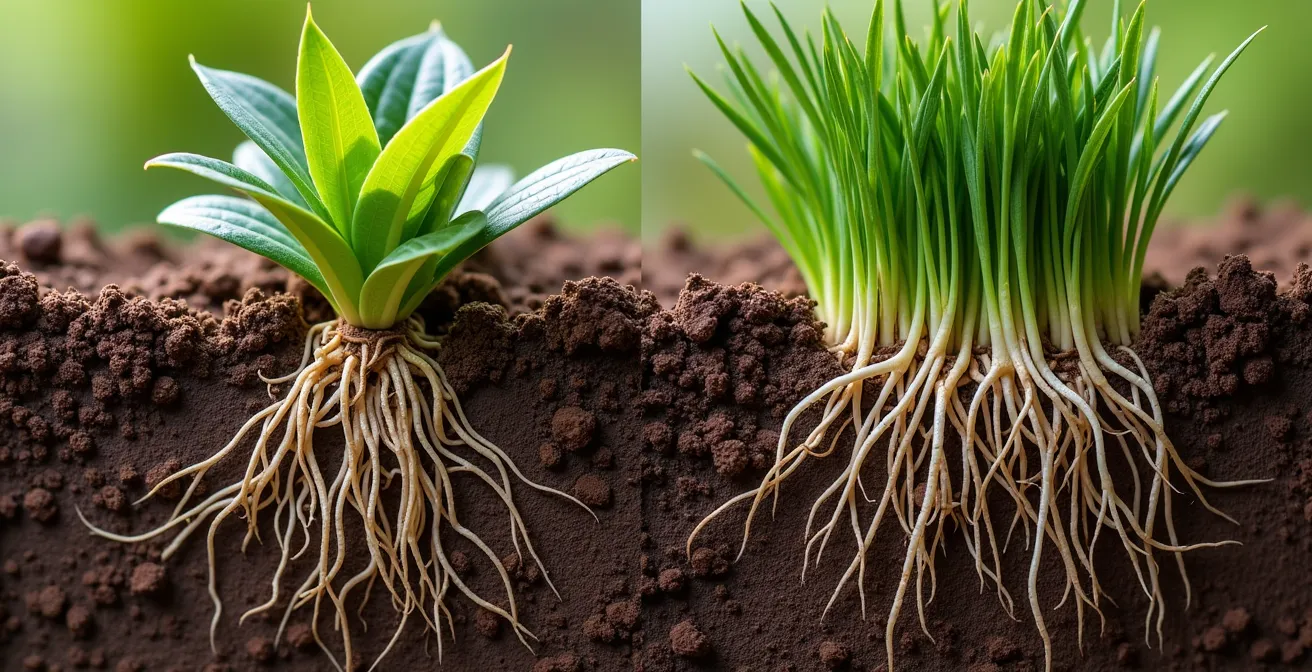
To design a garden that doesn’t create future work, you must understand a plant’s “personality”—its innate growth habit. Perennials spread in two primary ways: by forming a “clump” that slowly expands from the center, or by sending out underground runners (rhizomes) to colonize new territory. Choosing the right plant behavior for the right spot is the difference between a well-behaved garden and a chaotic war zone. Neither bulbs nor rhizomes are inherently “faster”; it all depends on the specific plant.
Clumping perennials are the polite citizens of the garden. Plants like Hostas, Heuchera, and Peonies grow in predictable, tidy mounds. They get wider each year but won’t pop up unexpectedly a foot away from where you planted them. This makes them ideal for mixed borders and formal designs where you need to maintain clear lines between different plants. Their predictable growth is the cornerstone of a low-maintenance design because you can place them and be confident they will stay put.
In contrast, spreading perennials (often rhizomatous) are built to cover ground. This group ranges from “controlled spreaders” like Ajuga, which forms a dense but manageable mat, to “aggressive spreaders” like Mint, which can take over an entire bed in a single season. Aggressive spreaders are not inherently bad; they are simply a powerful tool that must be used correctly. They are excellent for difficult areas where you need tough erosion control or want to fill a large, contained space quickly. The mistake is planting an aggressive spreader in a polite mixed border without physical barriers. The following table breaks down these growth patterns to help you make strategic choices.
This illustration visually contrasts the two primary growth patterns. On the left, you see the dense, centralized root system of a clumping perennial, while the right side shows the horizontal, exploratory rhizomes of a spreader.
The following table, based on common design principles, helps clarify which type to use where for a low-maintenance garden.
| Type | Growth Pattern | Maintenance Level | Best Use | Examples |
|---|---|---|---|---|
| Clumpers | Expand from central point | Low – predictable growth | Specimen planting, mixed borders | Hostas, Heuchera, Peonies |
| Controlled Spreaders | Form moderate mat | Medium – occasional editing | Groundcover, erosion control | Ajuga, Creeping Phlox |
| Aggressive Spreaders | Rapid rhizome spread | High – requires barriers | Problem areas only | Mint, Bamboo, Lily of Valley |
The Mint Mistake: Perennials You Should Never Plant in the Ground
One of the most important decisions in a low-maintenance design is not what to plant, but what *not* to plant—at least not without strict containment. Many enthusiastic gardeners have learned this the hard way after planting a single, innocent-looking mint plant, only to find it sprouting everywhere two years later. These are the “garden thugs,” perennials so aggressive in their spreading habit that they should almost never be planted directly in a garden bed. Their rhizomes travel far and wide, choking out less vigorous neighbors and creating a maintenance nightmare.
The list of aggressive spreaders to be wary of is well-known to experienced gardeners. Besides Mint, it includes Running Bamboo, Bishop’s Weed (Aegopodium), Lily of the Valley, and Obedient Plant (which is famously disobedient). While they can be useful for covering a difficult, contained slope, they are a recipe for disaster in a mixed perennial border. The key to avoiding “The Mint Mistake” is to research a plant’s behavior before you buy it. Plant descriptions often contain code words that signal aggressive tendencies.
Look for code words that signal aggressive tendencies: ‘naturalizes readily,’ ‘vigorous spreader,’ ‘forms colonies’
– Garden Design Magazine, Low-Maintenance Perennials Guide
To make this easier, you can think of perennials on an aggressiveness scale. “Rating 1” plants are the slow, reliable clumpers like Peonies and Baptisia. “Rating 2 and 3” are manageable spreaders like Black-eyed Susans or Bee Balm, which may need editing every few years. “Rating 4 and 5” are the thugs that require serious consideration and containment, such as planting them in a pot that is then sunk into the ground. A smart gardener knows that sometimes the best maintenance is avoiding the problem in the first place.
When to Plant Tulips Before the Ground Freezes?
Spring-blooming bulbs like tulips, daffodils, and crocuses are essential components of a “set it and forget it” garden. They provide the first explosion of color after a long winter, often before many perennials have even begun to show new growth. The key to their success is proper planting time. These bulbs need a period of cold dormancy to trigger blooming, which means they must be planted in the fall. The ideal window is after the first light frost but before the ground freezes solid. This allows them enough time to develop a strong root system without sprouting top growth that would be killed by the winter cold.
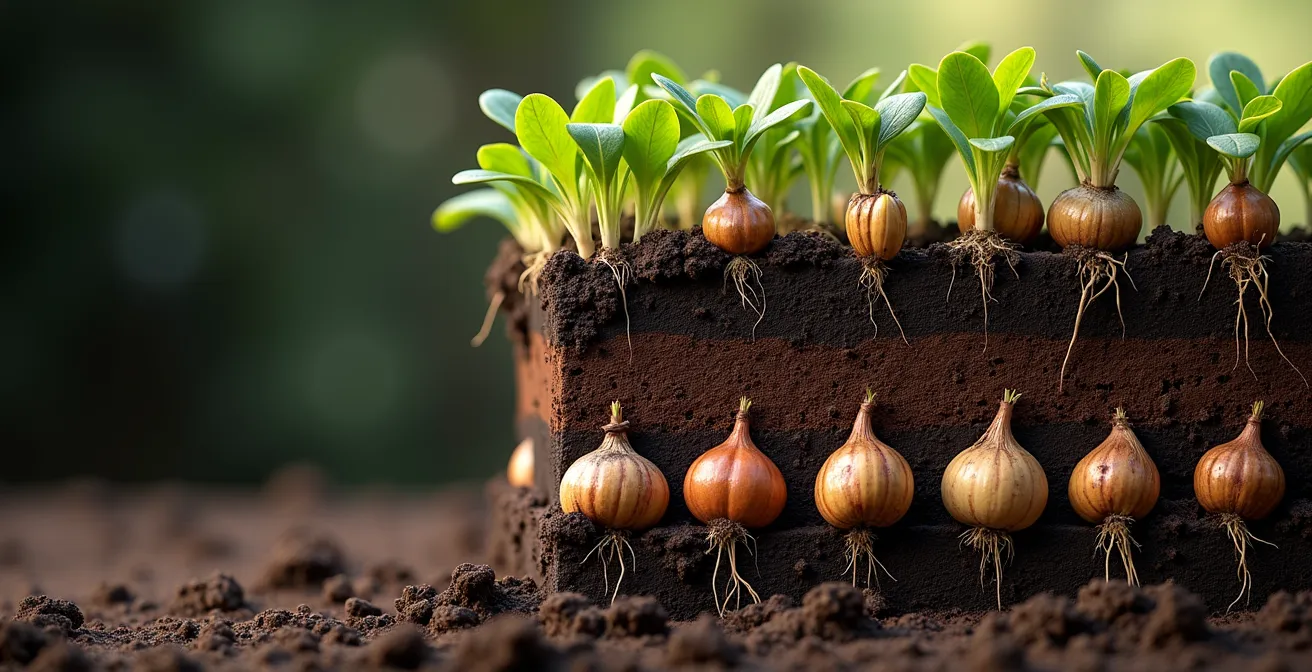
A truly efficient gardener maximizes every planting effort. This is where the “Bulb Lasagna” layering technique comes in. Instead of digging dozens of individual holes, you dig one larger, deeper hole and layer different types of bulbs within it. This creates a compact, long-lasting floral display that unfolds over several weeks from a single planting effort. The method is simple: large, late-blooming bulbs like tulips and daffodils go at the bottom (6-8 inches deep), medium-sized bulbs like hyacinths go in the middle layer (4-5 inches deep), and small, early-blooming bulbs like crocuses and grape hyacinths go in the top layer (2-3 inches deep). You cover each layer with soil before adding the next.
The result is a spectacular, condensed show. The small crocuses will bloom first, followed by the hyacinths, and finally the tall tulips will emerge, creating a continuous sequence of color for up to 8-10 weeks. This “perennial matrix” of bulbs fills the early spring gap and suppresses early weeds, all while your other perennials are just waking up. This cross-section shows how the bulbs are arranged at different depths to ensure they bloom in sequence without interfering with each other.
Why Native Plants Survive Heat Waves Better Than Imports?
The foundation of a truly resilient and low-effort garden is the use of native plants. These are species that have evolved over thousands of years in your specific local climate, soil conditions, and ecosystem. Unlike imported or exotic plants that may require constant coddling, natives are perfectly adapted to thrive with minimal intervention. They have developed deep root systems to withstand local drought patterns, built-in resistance to local pests and diseases, and a life cycle timed to your region’s seasons. This inherent adaptation is why they sail through heat waves while imports wilt.
Choosing native plants radically reduces maintenance. Because they are suited to your soil, you’ll need less fertilizer. Because they are adapted to your rainfall patterns, you’ll need to water far less once they are established. In fact, research shows that native plant gardens typically require 60% to 80% less water and maintenance than gardens of non-native species. This isn’t just about saving time and money; it’s about creating a self-regulating garden ecosystem. Native plants provide the perfect food and shelter for local pollinators like bees and butterflies, which in turn helps create a healthier, more balanced garden that is less reliant on chemical pesticides.
Think of it as building a garden with a home-field advantage. You are choosing players who already know the rules of the local environment. A gardener who opts for native species is taking a lower-risk, higher-reward approach. They are not fighting against nature; they are partnering with it. This creates a landscape that is not only beautiful and low-maintenance but also ecologically functional, supporting the wildlife that has depended on these plants for centuries.
Pavers or Grass: Which Costs Less to Maintain Over 10 Years?
A significant part of a “set it and forget it” landscape strategy is looking beyond plants and analyzing the highest-maintenance areas of your yard. For most homeowners, that area is the traditional lawn. A green, manicured lawn is an icon of curb appeal, but it’s a voracious consumer of time, water, and money. It requires constant mowing, fertilizing, and weeding. In fact, the American Time Use Survey reveals that the average American spends 70 hours annually on lawn and garden care, with a large portion of that dedicated to the lawn.
When you look at the time-cost horizon over a decade, the numbers are revealing. While a lawn may have a lower initial installation cost, its annual maintenance fees add up quickly. Hardscaping options like paver patios or pathways, or converting lawn space to a perennial garden, have a higher upfront cost but dramatically lower long-term maintenance in both time and money. A paver patio might only require occasional sweeping and weeding between cracks, while a well-designed perennial garden, once established, needs far less attention than a lawn.
The following analysis, based on industry averages, compares the estimated 10-year total cost of ownership for these three common landscaping options. It forces a strategic re-evaluation of what “low-cost” really means. The initial sticker price is only a small part of the story; the true cost is measured over years of maintenance.
| Option | Initial Cost | Annual Maintenance | 10-Year Total | Time/Year |
|---|---|---|---|---|
| Traditional Lawn | $500-1000 | $500-800 | $5,500-9,000 | 70+ hours |
| Paver Installation | $3000-5000 | $50-100 | $3,500-6,000 | 5 hours |
| Perennial Garden | $1500-2500 | $100-200 | $2,500-4,500 | 20 hours |
Key takeaways
- Design your garden for its end-of-season appearance by including late-blooming perennials and plants with lasting foliage.
- Master plant behavior—especially the difference between polite clumpers and aggressive spreaders—to prevent future maintenance nightmares.
- Make native plants the resilient backbone of your garden ecosystem to drastically reduce the need for water, fertilizer, and pest control.
How to Landscape Your Front Yard to Boost Curb Appeal by 10%?
A “set it and forget it” garden is not just about saving time; it’s also a smart financial investment. Thoughtful, well-maintained landscaping has a direct and positive impact on your property’s value. While a neglected yard can detract from a home’s appeal, a beautiful and—importantly—sustainable landscape is a major selling point. Professional landscaping that incorporates a mix of perennial beds, attractive hardscaping like patios, and mature plants can significantly enhance a property’s curb appeal, with studies showing it can potentially boost its resale value by 10-20%. Homebuyers are increasingly looking for attractive, move-in-ready outdoor spaces that don’t project years of future work.
To achieve this high-impact look without creating a high-maintenance burden, designers rely on simple but powerful principles. One of the most effective is the “Power of Three” (or any odd number). Instead of planting one of everything, creating a chaotic “collector’s garden,” you should plant in small drifts of three, five, or seven of the same plant. This repetition creates a sense of rhythm and cohesion that is pleasing to the eye. It guides the viewer’s gaze through the landscape and makes the design feel intentional and unified, rather than random. Using larger masses of the same plant is especially important for properties viewed from a distance, as it creates a more significant visual impact.
By combining the principles we’ve discussed—choosing well-behaved native plants, layering for four-season interest, and arranging them in deliberate, rhythmic groups—you create a landscape that is both beautiful and largely self-sustaining. This is the ultimate goal: a front yard that not only welcomes you home every day but also works to increase the value of your single biggest asset, all while demanding very little in return.
Action plan: Auditing Your Yard’s Low-Maintenance Potential
- Points of contact: List all areas requiring regular maintenance (e.g., lawn mowing, annual flower beds, weedy patches, high-water plants).
- Collect data: Inventory existing perennials. Note which ones are thriving vs. struggling, and identify their growth habit (clumper or spreader).
- Check for coherence: Compare your list to a list of recommended native plants for your specific region. How many of your plants are naturally adapted?
- Assess emotional impact: Identify the “dead zones” in your yard during late summer and fall. Where could late-season bloomers or foliage plants make the biggest impact?
- Draft an integration plan: Prioritize one high-maintenance area (e.g., a section of lawn) to convert into a low-maintenance perennial bed this season.
Now that you have the blueprint, the next step is to assess your own space. Start by auditing one section of your yard using these principles to plan your ‘set it and forget it’ transformation.