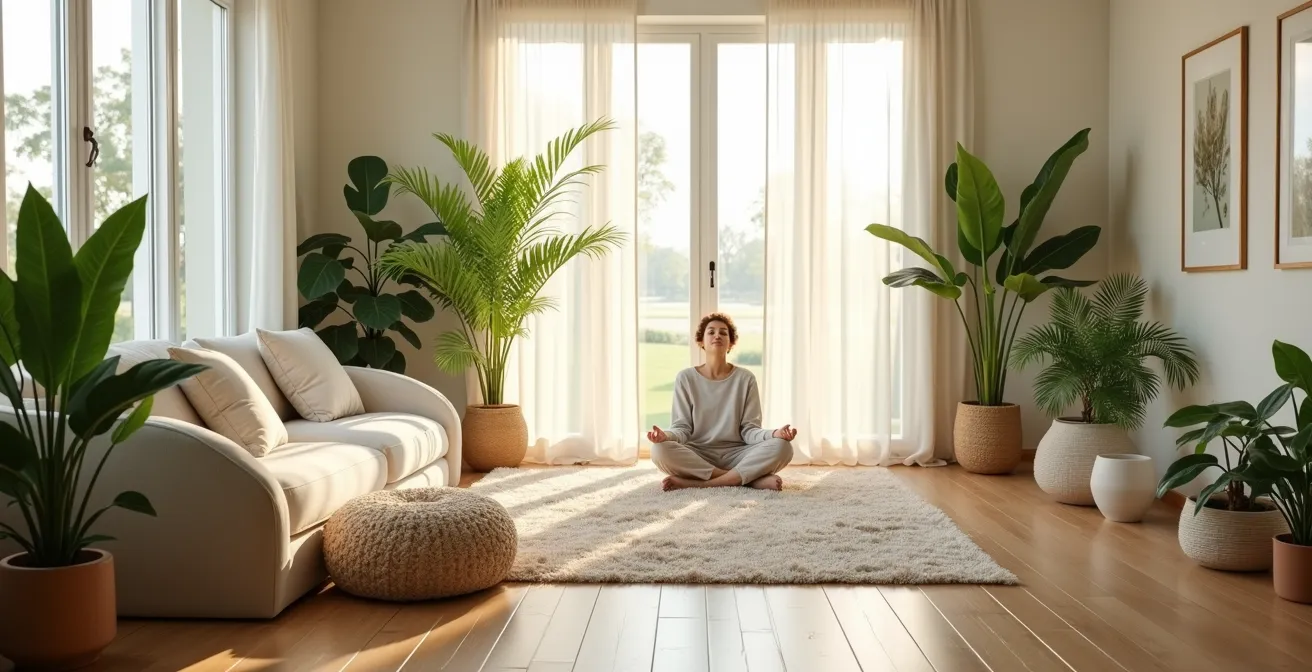
The persistent anxiety you feel at home often goes beyond simple clutter or a lack of light. True environmental design for stress reduction involves treating your home as a sensory ecosystem that directly influences your nervous system. By consciously curating social cues, creating zones for all emotions (not just calm), and designing intentional transitions, you can transform your living space from a passive backdrop into an active tool for regulating chronic stress and fostering genuine well-being.
Does the anxiety you feel throughout the day follow you home, greeting you the moment you walk through the door? For many, home is no longer a sanctuary but another source of subtle, chronic stress. The common advice often circles around decluttering, adding a few plants, or painting a wall a calming color. While these tips have merit, they only scratch the surface of a much deeper truth.
The real power lies in understanding your home not as a collection of furniture and decor, but as a complex sensory ecosystem that is in constant dialogue with your nervous system. But what if the key to a stress-reducing home wasn’t just about creating “good vibes only,” but about designing a space that acknowledges and supports your full range of human emotions? This is the core of environmental therapy: using design as a conscious, therapeutic tool.
This guide will move beyond superficial fixes to explore how you can strategically shape your environment—from the arrangement of your patio furniture to the ritual of your morning coffee—to actively down-regulate your body’s stress response. We will delve into the psychology of space, showing you how to manage sensory inputs, foster connection, and create intentional transitions that signal safety and calm to your brain.
For those who prefer a visual format, the following video offers complementary ideas, exploring how psychological principles can be applied to create a home that promotes well-being and a sense of peace.
This article provides a structured approach to transforming your home into a haven for your nervous system. Each section addresses a specific, science-backed strategy you can implement to reduce chronic stress through thoughtful design.
Summary: A Psychologist’s Framework for a Stress-Reducing Home
- Why Loneliness Is as Deadly as Smoking 15 Cigarettes a Day?
- How to Use Nature Walks to Lower Cortisol in 20 Minutes?
- Integrative Medicine or Conventional: When Do You Need Both?
- The Danger of Ignoring Negative Emotions for “Good Vibes Only”
- How to Create a Morning Ritual That Sets a Calm Tone for the Day?
- How to Arrange Patio Seating to Encourage Conversation?
- How to Create a Mental Commute When You Work From Your Bedroom?
- How to Landscape Your Front Yard to Boost Curb Appeal by 10%?
Why Loneliness Is as Deadly as Smoking 15 Cigarettes a Day?
The phrase might sound like an exaggeration, but the physiological impact of loneliness is profound and well-documented. Chronic social isolation places the body in a prolonged state of high alert, increasing inflammation and stress hormone levels. This isn’t just a fleeting feeling of sadness; it’s a persistent biological state that wears down the body over time. Landmark research shows a 26% increased risk of premature death associated with loneliness, a mortality risk comparable to smoking or obesity. A 2023 advisory from the U.S. Surgeon General even declared loneliness a public health epidemic, highlighting its severe consequences.
Your home environment plays a critical role as either an antidote or an amplifier to this epidemic. A home designed with only individual pursuits in mind—think rooms filled with screens and seating that faces away from others—can inadvertently foster isolation. Conversely, a home can be a powerful tool for building what psychologists call social connectedness. This involves intentionally designing spaces that invite interaction, facilitate shared experiences, and lower the barriers to connection. It’s about creating an environment where community can flourish organically, turning your home into a frontline defense against the health risks of isolation.
The design of your living space can either push people apart or gently pull them together, directly impacting your long-term health.
How to Use Nature Walks to Lower Cortisol in 20 Minutes?
The title of this section points to a powerful truth: exposure to nature has a rapid and measurable effect on our stress levels. The prompt to take a “nature walk” is a prescription for lowering cortisol, the body’s primary stress hormone. In fact, research confirms that just 20 minutes in a natural setting can significantly reduce cortisol levels. But what if you could bring that same therapeutic effect indoors, making it accessible even on the busiest days? This is the principle behind biophilic design: the practice of integrating nature into our built environments.
This goes far beyond simply adding a few houseplants. It’s about creating a rich, multi-sensory natural experience within your home. The goal is to build a “biophilic journey” that engages all your senses. This could involve using natural materials like wood, stone, and linen to provide varied textures; positioning furniture to maximize views of the sky or trees; and using mirrors to reflect and amplify natural light and greenery. The key is variety and immersion, creating an indoor sanctuary that calms the nervous system.

As this image shows, focusing on the macro details of natural textures can create a powerful calming effect. Incorporating low-maintenance plants like Snake Plants or Pothos improves air quality and mood, while the sound of a small water feature can mask stressful artificial noises. By thoughtfully layering these elements, you weave the restorative power of nature directly into the fabric of your daily life, creating a home that continuously works to lower your stress.
Your home can become a constant source of nature-based therapy, no walk required.
Integrative Medicine or Conventional: When Do You Need Both?
The concept of integrative medicine—combining conventional medical treatments with evidence-based complementary therapies—offers a powerful lens through which to view home design. Your environment is not separate from your health; it is an active component of it. While conventional medicine addresses symptoms and diseases, an integrative approach acknowledges that your surroundings can either support or sabotage your well-being. This is where your home becomes a therapeutic partner.
Think of your home’s sensory inputs as a form of “environmental medicine.” Just as you are mindful of what you eat, you must be mindful of what your senses consume. As interior design expert Joanna Thornhill notes, the visual landscape of our homes can be as stimulating as caffeine:
Visual stimulants in the home can be just as detrimental to relaxation and well-being as ingested stimulants such as caffeine. Both can contribute to an anxious, racing mind and an inability to switch off.
– Joanna Thornhill, Living Etc – Interior Design Expert
This means that a chronically cluttered countertop, a blinking electronic light, or a visually chaotic room can contribute to an elevated state of stress, just like a poor diet or lack of exercise. An integrative approach to health, therefore, requires you to see home design not as decoration, but as a critical health intervention. You need both: the doctor to treat an acute condition, and a well-designed environment to support your nervous system’s long-term regulation and prevent the build-up of chronic stress.
Your home’s design should be a fundamental part of your wellness plan, working in concert with, not against, your health goals.
The Danger of Ignoring Negative Emotions for “Good Vibes Only”
A common mistake in designing for well-being is the pursuit of relentless positivity. The “good vibes only” philosophy, when applied to a home, can create an environment where there is no safe space to process difficult emotions like sadness, frustration, or grief. Suppressing these feelings doesn’t make them disappear; it forces them to surface in unhealthy ways, contributing to anxiety and a sense of inauthenticity in your own sanctuary. A truly healthy home is not one that is always happy, but one that is emotionally honest.
This is where the concept of “Emotional Zoning” becomes a transformative design tool. It involves creating distinct areas in your home that are intentionally designed to support a spectrum of emotional states. Instead of making every room bright and airy, you might design a “contemplation corner” with moody, darker hues, soft textures, and a weighted blanket, creating a safe haven for introspection or processing difficult news. Conversely, another area could be designed for joy and energy, using vibrant, warm colors and stimulating decor.
Case Study: Emotional Zoning in Practice
Research into home design and mental health has shown the power of this approach. One family, struggling with ambient anxiety, transformed a spare room into a “letting go” space. They used dark, calming colors and soft, sound-dampening textures. This became the designated place where family members could go to safely express difficult emotions without judgment. Six months later, they reported feeling significantly less anxious at home and more emotionally connected with one another, having created a physical space that validated their complete emotional experience.
By creating designated spaces for different feelings, you give yourself and your family permission to be fully human. You build an environment that says, “All of you is welcome here.” This validation is profoundly calming and is a cornerstone of creating a home that genuinely reduces chronic stress.
Your Action Plan for Emotional Zoning
- Designate a ‘contemplation corner’ with moody, dark hues for introspection and a safe space for sadness.
- Create a vibrant, stimulating area with warm colors (like yellows or oranges) to actively foster joy and energy.
- Establish a neutral, quiet “reset” space with soft textures and minimal decor for when you feel overwhelmed.
- Incorporate grounding sensory tools like weighted blankets or textured wall hangings in your contemplation zone for anxiety relief.
- Reserve specific, unique scents (like earthy vetiver or frankincense) only for use in your contemplation space to create a strong sensory cue for processing difficult emotions.
–
A home that makes space for sadness is ultimately a more joyful and less stressful place to be.
How to Create a Morning Ritual That Sets a Calm Tone for the Day?
A calming morning ritual is one of the most effective strategies for managing chronic stress, but its success is deeply tied to the environment in which it takes place. The foundation for a calm morning is laid the night before, with adequate sleep. Sleep is when your body does its most important work in regulating stress hormones. In fact, Henry Ford Health research indicates that getting 7-8 hours of quality sleep can reduce cortisol levels by as much as 50%. Your bedroom’s design—cool, dark, and quiet—is the first step in this ritual.
When you wake, the goal is to gently transition your nervous system into the day, avoiding the sudden jolt of stress that comes from checking your phone first thing. This is where your environment becomes an active participant. Instead of stumbling into a chaotic kitchen, you can design a small, dedicated “ritual space.” This doesn’t have to be a whole room; it can be a single comfortable chair by a window, a clean corner of your kitchen counter, or a cushion on the floor. The key is that this space is reserved for a calming activity, like sipping tea, journaling, or simply breathing for a few minutes.

This space should be a sensory haven. It should have access to soft, natural morning light, feature comfortable textures, and be free of clutter and digital distractions. By consistently starting your day in this purpose-designed sanctuary, you create a powerful Pavlovian response. Over time, simply entering that space will begin to trigger a relaxation response in your body, setting a calm, resilient tone that you can carry with you throughout the day.
You are not just creating a routine; you are designing an automated, environmental cue for calm.
How to Arrange Patio Seating to Encourage Conversation?
The principles of creating a stress-reducing home extend beyond your four walls and into your outdoor spaces. The way you arrange your patio or garden seating can have a dramatic impact on social dynamics, either fostering connection or creating subtle barriers. This concept is explored in a field of study called socio-architecture, which distinguishes between two fundamental types of seating arrangements: socio-petal and socio-fugal. Understanding this distinction is key to designing for connection.
Socio-petal arrangements pull people together. Think of chairs arranged in a circle or a U-shape around a fire pit. This configuration encourages face-to-face interaction, eye contact, and a sense of shared community. It is ideal for intimate gatherings and deep conversations. In contrast, socio-fugal arrangements push people apart. Benches in a straight line, like those in a waiting room, discourage interaction and create personal space. This is better for individual relaxation, like reading a book. Consciously choosing a socio-petal layout is a direct way to use design to combat the loneliness discussed earlier.
The following table, based on an analysis of social design principles, breaks down these arrangements to help you choose the right one for your needs.
| Arrangement Type | Configuration | Social Effect | Best For |
|---|---|---|---|
| Socio-petal (Circular) | Chairs facing inward in circle or semi-circle | Encourages interaction and eye contact | Intimate gatherings, deep conversations |
| Socio-fugal (Linear) | Benches or chairs in straight lines | Reduces interaction, creates personal space | Individual relaxation, reading |
| L-Shaped | Corner arrangement with 90-degree angle | Balanced interaction without forced eye contact | Casual conversations, flexible groups |
| U-Shaped | Three-sided arrangement around focal point | Creates community feel with central focus | Fire pit gatherings, group activities |
Beyond the physical arrangement, sound design is another critical layer. A noisy urban patio can make conversation stressful. A case study on outdoor spaces found that strategically placing sound-dampening plants like bamboo and adding a gentle water feature to mask traffic noise dramatically improved the social quality of the space. Guests spoke more quietly, stayed longer, and used the space more frequently. This shows that designing for conversation is a multi-sensory task.
You are not just placing furniture; you are choreographing human connection.
How to Create a Mental Commute When You Work From Your Bedroom?
When your bedroom doubles as your office, the lines between work and rest become dangerously blurred. Without a physical journey to separate the two, your brain can remain in “work mode” long after you’ve closed your laptop, leading to burnout and chronic stress. The solution is to create a “mental commute”—a sensory ritual that signals a clear transition between your professional and personal self. This ritual acts as a buffer, allowing your nervous system to down-regulate and switch off.
The most effective mental commutes engage multiple senses to create a powerful psychological boundary. This involves creating distinct sensory profiles for “work time” and “home time.” For example, you might use a bright, focused task light during the day and switch to warm, ambient lighting in the evening. Scent is another powerful tool; diffusing a citrus essential oil can signal focus and energy, while switching to lavender or cedarwood can cue relaxation. The same principle applies to sound. According to the UW School of Medicine and Public Health, music therapy can effectively reduce cortisol and lower heart rate, making it a perfect tool for your commute. Create a specific “work” playlist (e.g., instrumental focus music) and a “wind-down” playlist (e.g., calm ambient sounds) and use them consistently.
The ritual can also have a physical component. Some people find it helpful to literally pack away their work items—laptop, notebooks, pens—into a dedicated box at the end of the day. This simple act of “packing up” mimics the end of a traditional workday and visually removes work from the living space. You can even use a specific rug under your desk that you roll up at the end of the day, physically erasing the “work zone.” The key is consistency. By performing the same sensory-shifting ritual every day, you train your brain to recognize the transition and truly leave work behind, even when you haven’t left the room.
Your commute may only be a few feet, but with the right rituals, it can be as effective as a cross-town journey.
Key Takeaways
- Your home is a sensory ecosystem; every design choice is an input that affects your nervous system.
- Design for a full range of emotions with “emotional zones,” not just for perpetual calm.
- Foster social connection through seating arrangements that encourage interaction (socio-petal design).
How to Landscape Your Front Yard to Boost Curb Appeal by 10%?
While curb appeal is often framed in terms of property value, its most significant benefit may be psychological. The journey from the street to your front door is the final leg of your commute and the first moment of your transition into sanctuary. Reframing your front yard’s purpose from “curb appeal” to “arrival therapy” can transform your daily experience of coming home. The goal is to design a pathway that actively de-stresses you before you even turn the key.
This involves choreographing a sensory experience. Instead of a straight, rigid concrete path, consider a gently curving walkway. Curves are more natural and force a slightly slower, more mindful pace. Line this path with elements that engage the senses in a calming way. Ornamental grasses that rustle in the wind provide gentle, natural sound. Fragrant plants like lavender or jasmine release calming scents as you walk past. Soft, warm landscape lighting can create pools of light that guide you in a serene, welcoming manner, rather than harsh, glaring floodlights.

One innovative home builder, TJH, implemented this “arrival therapy” concept in their designs. By using curved pathways and focusing on sensory landscaping, they created a measurable effect. Homeowners reported feeling noticeably calmer upon arriving home, with wearable devices showing a significant reduction in heart rate during the short walk from their car to the door. This demonstrates that the walk to your front door is a powerful and often overlooked opportunity to begin the process of nervous system regulation. It’s the first and most crucial step in shedding the stress of the outside world.
By designing a therapeutic arrival, you can begin to feel at peace before you even step inside. The next step is to observe your own home’s sensory inputs and take one small action—be it adjusting a light or rearranging a chair—to begin transforming your space into a true sanctuary that supports your well-being.