
The common advice to “learn to code” is dangerously obsolete. Future-proofing a career isn’t about one specific skill, but about understanding the three great economic shifts of our time.
- Deglobalization is creating a new class of high-tech manufacturing jobs on home soil.
- The green transition offers a direct, valuable path for skill transfer from old industries into new ones.
- The “human-touch” premium is making jobs in care, creativity, and community uniquely resilient to automation.
Recommendation: Equip your teenager with a “career compass” to navigate these fundamental shifts, rather than a map to a specific job that may not exist in a decade.
As a parent, guiding your teenager toward a stable and fulfilling career feels like navigating a fog. The ground beneath the labor market is shifting, and the old maps—”go to college, get a good job”—seem increasingly unreliable. You hear the constant drumbeat about AI and automation, and the default advice often becomes a simplistic “learn to code” or a vague encouragement to pursue “tech.” This is well-intentioned, but it misses the bigger picture entirely.
The Fourth Industrial Revolution isn’t just about technology; it’s about deep, structural changes in how the world operates. Relying on a list of “hot jobs for 2025” is like trying to predict the weather a year from now. It’s a fool’s errand. The real key to advising your child isn’t to give them a destination, but to provide them with a compass. This compass is built on understanding the powerful, underlying tectonic shifts shaping our economy.
Forget trying to outpace the robots. Instead, the truly visionary approach is to identify where the new currents of value are flowing. This article will look beyond the headlines about AI and explore three fundamental forces that are redefining the landscape of work: the strategic return of manufacturing through deglobalization, the massive skill arbitrage created by the green energy transition, and the rising economic value of the “human-touch premium” in a world saturated by the digital. By understanding these forces, you can help your teen build not just a career, but a resilient and adaptable skill ecosystem for life.
This guide will provide a framework for thinking about career resilience, moving from broad economic trends to specific, actionable strategies. We will explore where real growth is happening, how to assess skills for longevity, and why some of the most future-proof paths may not lead through a traditional university at all.
Summary: Navigating the Tectonic Shifts of the Future Labor Market
- Why Deglobalization Is Bringing Factory Jobs Back Home?
- How to Transfer Skills From Oil and Gas to Green Energy?
- Service Economy or Manufacturing: Where Is the Wage Growth?
- The Career Risk of Being Too Specialized in a Shrinking Niche
- When to Pivot Your Business Model Before Your Industry Dies?
- How to Spot the Next Silicon Valley Before Real Estate Booms?
- Which Global Cultural Shift Will Impact Your Local Market Next?
- Why a Trade Certification Can Pay More Than a University Degree?
Why Deglobalization Is Bringing Factory Jobs Back Home?
For decades, the narrative was simple: manufacturing jobs were inevitably moving overseas to lower-cost regions. That era is decisively ending. A powerful trend of reshoring—bringing manufacturing back to domestic soil—is reshaping the industrial landscape, driven by fragile supply chains, geopolitical tensions, and a new emphasis on national resilience. This is not a return to the assembly lines of the 20th century. This is the birth of the smart factory.
The numbers confirm this tectonic shift. A recent report highlights that reshoring and foreign direct investment are on track to announce a record of over 244,000 U.S. jobs in 2024 alone. Crucially, these aren’t the low-skilled jobs of the past. The growth is concentrated in high-value sectors. Today’s “factory job” is more likely to be a robotics technician, an automation engineer, or a data analyst overseeing a complex, digitized production process.
This new manufacturing requires a sophisticated skill ecosystem. The focus is on individuals who can work alongside automated systems, maintain complex machinery, and use data to optimize production. These are roles that blend traditional engineering with digital literacy, creating a new class of well-paid, highly skilled industrial workers.
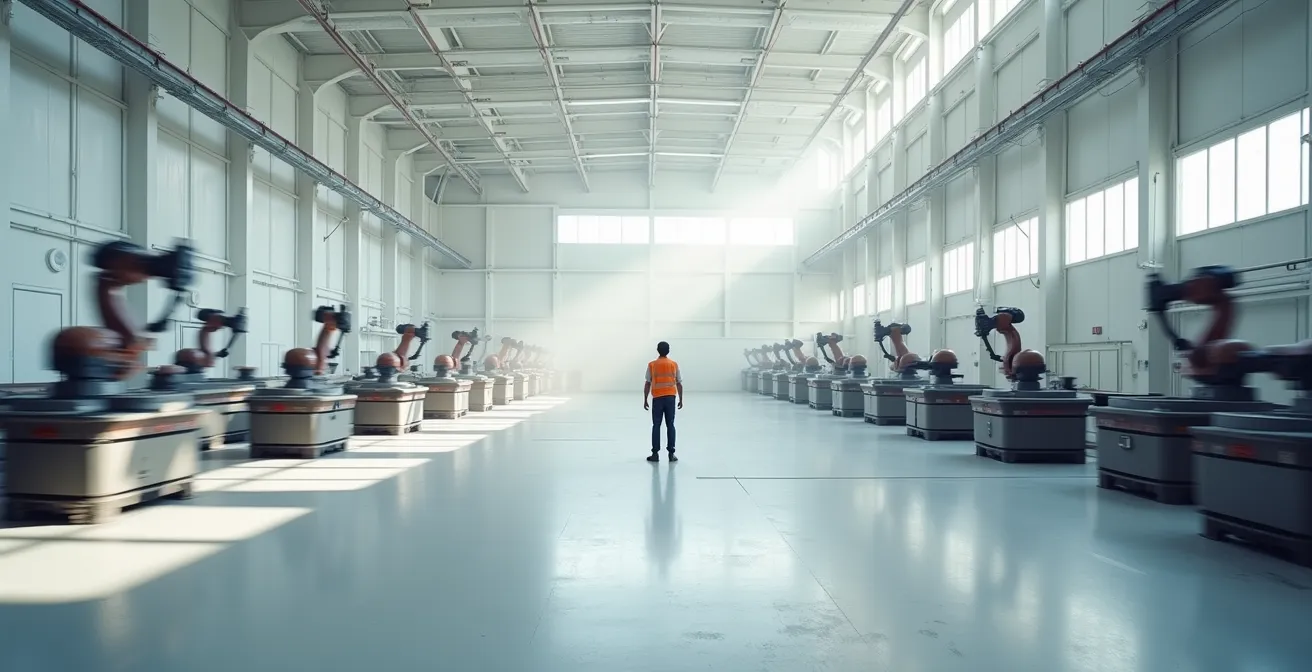
As the illustration suggests, the future factory is a clean, high-tech environment where human oversight and problem-solving are paramount. For a young person, this means opportunities in mechatronics, industrial IoT (Internet of Things), and advanced manufacturing are not just niche fields but central pillars of the new industrial economy. The key is to see “manufacturing” not as a relic of the past, but as a frontier of innovation.
How to Transfer Skills From Oil and Gas to Green Energy?
The second major tectonic shift is the global transition toward sustainable energy. While this is often framed as the “death” of old industries like oil and gas, a more insightful view sees it as a massive opportunity for skill arbitrage. The expertise honed in extractive industries is not becoming obsolete; it’s becoming incredibly valuable in the burgeoning green energy sector. The challenge is not a lack of skills, but a failure to recognize their transferability.
The overlap is staggering. Research from Offshore Energies UK estimates that an incredible 90% of the UK’s oil and gas workforce have skills that are transferable to the renewables sector. This isn’t just wishful thinking; it’s a practical reality. A petroleum engineer’s knowledge of subsurface geology is directly applicable to geothermal energy. A project manager who has overseen the construction of a massive offshore oil rig has the perfect experience to manage the development of an offshore wind farm.
This principle extends across numerous domains. Geoscience skills are critical for carbon capture and underground storage projects. Expertise in estimating reserves can be repurposed for assessing sites for hydrogen storage. The rigorous safety culture and regulatory compliance demanded in oil and gas are highly sought-after in all forms of energy production. This is a powerful lesson for a young person: deep expertise in a fundamental engineering or scientific discipline provides career resilience, as the *application* of that skill can pivot while the core knowledge remains valuable.
Service Economy or Manufacturing: Where Is the Wage Growth?
While reshoring revitalizes manufacturing, it’s crucial not to overlook the other powerhouse of the modern economy: services. However, the future of service work is splitting into two distinct paths. One path is being aggressively automated by AI—think chatbots replacing customer service reps. The other path, however, is becoming more valuable than ever. This is the realm of the “human-touch premium,” where jobs are defined by empathy, creativity, personalized care, and complex problem-solving.
These are the roles that are inherently resistant to automation. They include healthcare professionals, therapists, high-level educators, elder care specialists, and creative artists. As routine tasks become commoditized by technology, the market places a higher and higher value on genuine human connection and nuanced understanding. This is where real, sustainable wage growth will be found in the service sector. As futurist Shah notes in the PBS documentary “Future of Work,” these domestic, human-centric jobs are not just coming; they are “here to stay” and represent the future of the economy.

At the same time, the manufacturing resurgence is driving its own wage growth, but through a different mechanism: a skilled labor shortage. As demand for technicians and tradespeople outstrips supply, wages are rising. An indicator of this is the significant 83% increase in manufacturing apprenticeships over the past decade, signaling a sector investing heavily in its future workforce. For a young person, the choice isn’t “manufacturing vs. service,” but rather identifying where they can develop a deep, non-automatable skill—be it the technical mastery of a specialized machine or the empathetic mastery of human interaction.
The Career Risk of Being Too Specialized in a Shrinking Niche
In a rapidly changing world, the traditional career model of becoming a deep expert in one narrow field—the “I-shaped” professional—is becoming a high-risk strategy. If that niche is disrupted by technology or market shifts, the specialist is left with nowhere to pivot. The future demands more resilience. This has given rise to the concept of the “T-shaped” professional: someone with deep expertise in one area, but with broad knowledge across many others, allowing for context and collaboration.
However, the next-generation model for career resilience is the Pi-shaped (π) professional. This individual cultivates deep expertise in *two* distinct, and often complementary, domains. Think of a lawyer who is also a certified data scientist, or a marketing expert who is also a sustainability specialist. This dual specialization creates immense value and adaptability. If one field wanes, the other provides a strong foundation to stand on, and the intersection of the two often creates unique, high-demand roles that no one else can fill.
The following table, based on analysis from professional organizations like the IEEE, breaks down this evolution and clarifies why the Pi-shaped model is the strategic goal for a young person entering the workforce.
This comparison from an analysis by IEEE USA on the future of work highlights a clear trend towards multi-skilled professionals.
| Model | Structure | Advantage | Example |
|---|---|---|---|
| T-Shaped | One deep expertise + broad knowledge | Traditional specialization with context | Software engineer with business awareness |
| Pi-Shaped (π) | Two deep expertises + broad knowledge | Resilience through dual specialization | Lawyer who is also a certified data scientist |
| Future Requirement | Multiple deep skills + continuous learning | Adaptability to rapid market changes | Engineer with AI expertise and sustainability certification |
So, how can a teenager audit their potential career path for this kind of resilience? It’s about regularly stress-testing their chosen field against the forces of change. This requires moving from a passive choice to an active, strategic analysis of their niche’s viability.
Your Niche Viability Audit Checklist
- Assess automatability: Can AI or robotics perform 50% or more of your core tasks?
- Evaluate technology dependency: Does your expertise rely on a single software platform or proprietary tool?
- Measure application breadth: Can your core skills be transferred to at least three different industries?
- Check for regulatory protection: Are there certifications or licenses required that create a barrier to entry for others?
- Analyze market demand: Is hiring for your specialty projected to increase or decrease over the next 5-10 years?
When to Pivot Your Business Model Before Your Industry Dies?
The same forces that render individual careers obsolete can decimate entire industries. For any professional, whether an employee or an entrepreneur, the ability to read the “leading indicators” of disruption is a critical survival skill. Waiting for the crisis to hit is too late; the pivot must begin when the first faint signals of change appear on the horizon. The Fourth Industrial Revolution is defined by the convergence of exponential technologies, which can make established business models irrelevant almost overnight.
Recognizing these early warnings is a form of strategic foresight. Instead of focusing on current competitors, one must look for the disruptive threats that are just beginning to emerge. This involves a shift in perspective from managing the present to actively scouting the future. The key is to be attuned to the subtle shifts that precede a market earthquake.
Leading Indicators for an Industry Pivot
A Fast Company analysis on the Fourth Industrial Revolution highlights several key indicators that signal an impending disruption. Companies and individuals must watch for these signs. Firstly, track venture capital investment: a consistent decline of VC funding in your sector is a major red flag. Secondly, watch for the emergence of “good enough” substitute technologies that can serve 80% of customer needs at 20% of the cost; they often start at the low end of the market before moving up. Finally, listen to how customers talk about their needs. A shift in language from product-focused desires (e.g., “I need a faster drill”) to outcome-focused goals (e.g., “I need a better way to hang this picture”) signals that the underlying value proposition of an industry is changing.
This proactive mindset is essential. The convergence of AI, robotics, and other technologies will not just improve efficiency; it will fundamentally replace a wide swath of existing human jobs. The ability to see this coming and pivot—either by acquiring new skills or repositioning a business—is what separates those who are displaced from those who thrive in the new environment.
How to Spot the Next Silicon Valley Before Real Estate Booms?
Just as industries rise and fall, so do geographic centers of innovation. The same forces of reshoring and technological convergence are not happening uniformly across the country; they are concentrating in new, emerging hubs. For a young person, choosing where to live and build a career can be as important as choosing what to do. Identifying these future “Silicon Valleys” before they become household names—and before their real estate markets explode—is a powerful life strategy.
These emerging innovation clusters are not random. They are built on a specific set of foundational elements that create a fertile ground for growth. A strong research university, investment in future-ready infrastructure like fiber optic networks, and a vibrant local culture that attracts and retains talent are all key ingredients. By tracking these indicators, one can develop a map of where future opportunities are likely to concentrate.
While traditional tech hubs remain important, new data shows investment flowing to unexpected places. According to the latest data on reshoring, the top states for reshoring and foreign direct investment now include places like Texas, South Carolina, and Mississippi, driven by new battery plants, semiconductor fabs, and other advanced manufacturing facilities. This is creating high-wage, high-tech jobs far from the coastal megacities. To spot the next hotspot, you can use a scorecard of early indicators:
- University Patent Growth: Track the year-over-year growth in patent filings from local universities. A sustained increase signals a thriving R&D ecosystem.
- Cultural Vitality Markers: Monitor the per-capita density of independent coffee shops and craft breweries. While it may seem trivial, it’s a strong proxy for a culture that attracts young, creative talent.
- Infrastructure Readiness: Look for municipalities making significant investments in public fiber optic networks.
- Talent Migration Patterns: Use platforms like LinkedIn to follow talent flows. A “brain regain,” where skilled professionals are moving back from major metros, is a powerful signal.
- Early-Stage Investment: Watch for the opening of satellite offices by major venture capital firms. They are the canaries in the coal mine for innovation.
Which Global Cultural Shift Will Impact Your Local Market Next?
Beyond the economic and technological shifts, there is a deeper, more human current at play: a cultural backlash against digital saturation and a growing demand for authenticity. In a world of deepfakes, algorithmic feeds, and automated interactions, people are increasingly placing a premium on genuine human experiences, craftsmanship, and community. This “authenticity economy” is a powerful force that will shape the jobs and markets of the future.
This is the “why” behind the “human-touch premium.” It’s a move away from mass-produced and impersonal toward the unique, the local, and the meaningful. This shift creates value in areas that machines cannot replicate: artisanal crafts, community-based services, and roles that depend on trust and genuine connection. For those looking to future-proof their careers, building competencies in these areas—such as complex problem-solving, creativity, and social intelligence—is the ultimate defense against automation.

This is not about rejecting technology, but about finding a new balance. As Roy Siegel, a contributor to the PBS “Future of Work” series, eloquently states, we have agency in this process. He argues that work is a fundamental human need for pride and contribution, and reminds us that “we get to design what work is, it doesn’t just happen to us; the nature of work is designed by humans.”
It’s all about pride and contribution. I really believe that this is a basic human need. And so as we design future work– and remember, we get to design what work is, it doesn’t just happen to us; the nature of work is designed by humans.
– Siegel, PBS Future of Work Series
For a young person, this means that pursuing a passion in a creative or craft-based field is not a romantic indulgence but a viable economic strategy. The future will belong to those who can offer something real, tangible, and deeply human in an increasingly virtual world.
Key Takeaways
- Career resilience is no longer about a single “safe” job, but about building a “skill ecosystem” aligned with major economic shifts.
- The three key forces to watch are the reshoring of high-tech manufacturing, the skill transfer to the green economy, and the rising value of the “human-touch premium.”
- Advising a young person today requires providing them with a “career compass” to navigate these forces, rather than a fixed map to a specific occupation.
Why a Trade Certification Can Pay More Than a University Degree?
Given these tectonic shifts, the long-held belief that a four-year university degree is the only path to a successful career is not just outdated; it’s often financially unsound. The demand for skilled tradespeople—driven by the manufacturing renaissance and the green transition—has outpaced supply, leading to high wages and rapid career progression. When you factor in the immense cost of university and the opportunity cost of four years out of the workforce, a trade certification often offers a significantly higher and faster return on investment.
A university degree can still be the right path for many professions, particularly those in science, research, and academia. However, for a huge swath of the high-demand jobs of the future—the robotics technicians, the EV mechanics, the renewable energy system installers—a specialized, two-year certification is the more direct and efficient route. This path allows a young person to start earning sooner, avoid crushing student debt, and often provides a clearer path to entrepreneurship and business ownership.
The following comparison starkly illustrates the financial advantages that a trade certification can offer in the current economic landscape.
| Factor | 4-Year University Degree | 2-Year Trade Certification |
|---|---|---|
| Average Cost | $120,000-$200,000 | $15,000-$30,000 |
| Lost Income (Opportunity Cost) | 4 years × $35,000 = $140,000 | 2 years × $35,000 = $70,000 |
| Time to Positive ROI | 10-15 years | 2-4 years |
| Starting Salary Range | $40,000-$60,000 | $45,000-$75,000 (skilled trades) |
| Path to Business Ownership | Requires additional capital/MBA | Direct path with low overhead |
Furthermore, the most valuable certifications are directly tied to the growth sectors we’ve identified. These are not the trades of the past; they are sophisticated, high-tech roles essential to the new economy. For a teenager who is hands-on, practical, and eager to build, these paths offer not just a job, but a thriving, future-proof career.
- Commercial Drone Pilot Certification: Essential for logistics, agriculture, and infrastructure inspection.
- EV Mechanic Specialization: High demand as the automotive industry transitions to electric.
- Smart Home Automation Installer: Combines electrical, networking, and IoT skills.
- Industrial Robotics Maintenance: Critical for every automated manufacturing facility.
- Renewable Energy System Installer: Needed for solar, wind, and battery storage projects.
The conversation with your teenager about their future shouldn’t be a source of anxiety, but an exciting exploration. By equipping them with this framework—a compass to navigate the tectonic shifts of our time—you empower them to make informed, resilient choices. The goal is to start a dialogue focused not on “what job do you want?” but on “what problems do you want to solve, and in which growing skill ecosystem can you best do it?”