
The “all-or-nothing” approach to fitness is failing you; sustainable health comes from small, daily “movement snacks,” not exhausting weekly marathons.
- Consistent, low-intensity movement builds neurological habits and avoids the recovery debt that causes burnout.
- A functional fitness routine requires minimal space and less than $200, removing the biggest barriers to starting.
Recommendation: Swap one weekly, high-intensity gym session for 20 minutes of intentional movement each day to build a habit that actually lasts.
Does this sound familiar? You start a new gym routine with incredible motivation. For two weeks, you’re a machine—pushing hard, embracing the soreness, and dreaming of the results. Then, life happens. You’re exhausted, the initial excitement fades, and the thought of another grueling hour-long session feels impossible. Before you know it, your gym pass is gathering dust, and the cycle of guilt and resignation begins again. This isn’t a personal failure; it’s a system failure. The conventional wisdom of “go hard or go home” is built for athletes, not for busy people trying to build lasting health.
We’ve been taught to chase intensity, believing that soreness is the ultimate badge of honor. We debate the merits of cardio versus weights as if they are mutually exclusive paths. But what if this entire framework is wrong? What if the secret to fitness isn’t found in a single, heroic workout but in the small, almost effortless moments woven into your daily life? The true key isn’t intensity, but a radical commitment to consistency. It’s about shifting your mindset from “exercise” to “movement” and discovering the minimum effective dose that your body and schedule can sustain not just for a week, but for a lifetime.
This is the power of the 20-minute habit. This guide will dismantle the “no pain, no gain” myth and show you the science behind why short, daily sessions are superior for building habits, preventing injury, and aging gracefully. We will explore how to create a powerful home workout space for less than the cost of a few months’ gym membership, how to combine different types of movement for maximum benefit, and how to synchronize your activity with your body’s natural rhythms to boost energy and improve sleep. It’s time to get off the fitness rollercoaster and build a practice that serves you, every single day.
Before we dive into building habits that are truly sustainable, take a moment for this classic reminder about commitment and never letting you down. It’s a fitting soundtrack for our journey towards consistency that sticks.
To help you navigate this new approach, we’ve structured this guide to address the most common questions and hurdles. Each section builds on the last, providing a clear roadmap from understanding the “why” to implementing the “how.”
Summary: Your Roadmap to Sustainable Daily Movement
- Why You Don’t Need to Be Sore the Next Day to Build Muscle?
- How to Build a Functional Home Gym for Under $200?
- Cardio or Weights: Which Is Better for Aging Gracefully?
- The Squat Mistake That Destroys Knees Over Time
- When to Stop Exercising to Avoid Insomnia?
- How to Wake Up at the End of a Sleep Cycle to Avoid Groginess?
- Why You Are 65% More Likely to Finish a Workout With a Partner?
- How to Use Yoga to Fix Back Pain From Sitting All Day?
Why You Don’t Need to Be Sore the Next Day to Build Muscle?
The belief that muscle soreness, or Delayed Onset Muscle Soreness (DOMS), is a direct indicator of a “good” workout is one of the most persistent and damaging myths in fitness. For the busy person trying to build a consistent habit, chasing soreness is a recipe for burnout. DOMS is simply the result of microscopic muscle tears, usually from a new or unusually intense exercise. It is not a prerequisite for muscle growth (hypertrophy). In fact, severe soreness can be counterproductive, signaling that you’ve pushed too far, too fast.
When you’re cripplingly sore, you’re less likely to move the next day, breaking the chain of consistency that is so crucial for habit formation. Your body is forced to spend all its resources on extensive repairs rather than on adaptation and growth. Research shows that severe DOMS can be detrimental to performance. For instance, recent findings from 2024 reveal that a 43.5% decrease in eccentric strength can occur with severe DOMS, hindering your ability to train effectively for several days. This creates a vicious cycle of overexertion followed by forced inactivity, the exact opposite of a sustainable practice.
The goal of daily movement is to stimulate, not annihilate. A 20-minute session should leave you feeling energized and accomplished, not defeated. You are building muscle and improving fitness by sending a consistent, manageable signal to your body. Over time, your body adapts to this regular stimulus by becoming stronger and more efficient. True progress is measured in your ability to show up tomorrow, not in how much pain you feel today. Focus on consistent effort and proper form, and let go of soreness as your metric for success.
How to Build a Functional Home Gym for Under $200?
Another major barrier to consistency is the perceived need for an expensive gym membership or a room full of bulky equipment. This is a myth. You can create an incredibly effective and versatile workout space in the corner of a room for less than the cost of a few months at a commercial gym. The key is to invest in tools that support fundamental human movement patterns: pushing, pulling, hinging, squatting, and carrying. By focusing on function over flash, you build a “gym” that serves your body’s real-world needs.
Forget the complex machines that isolate single muscles. Your focus should be on a few key pieces that offer maximum versatility. An adjustable kettlebell, for example, allows you to practice hinges (swings), squats (goblet squats), and carries with a single tool, adjusting the weight as you get stronger. A set of resistance bands can cover all your pulling and pushing needs and takes up virtually no space. These simple tools are not a compromise; they are often superior for building functional, real-world strength that translates into daily life, from carrying groceries to playing with your kids.
The beauty of a minimalist home gym is its accessibility. There’s no travel time, no waiting for equipment, and no intimidating environment. It’s right there, ready for your 20-minute “movement snack.” This removes nearly all the friction that stops people from working out. Below is a practical breakdown of how you can build a complete, functional home gym for well under $200.
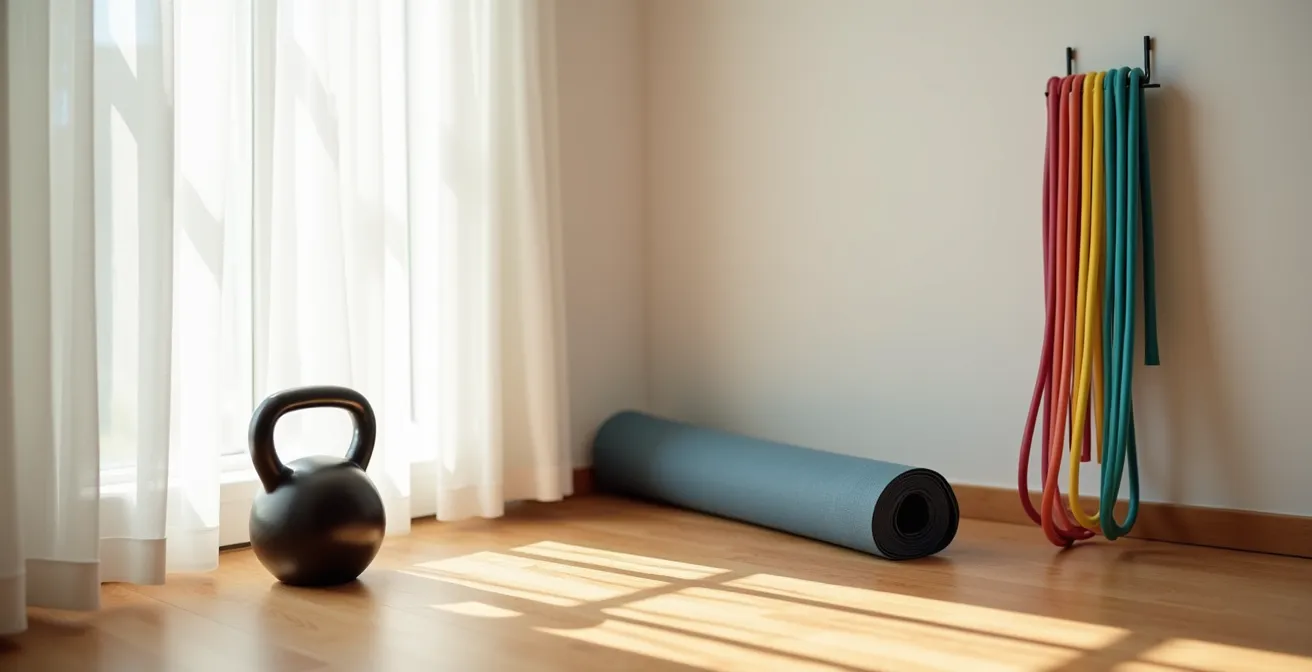
This setup demonstrates that you don’t need a dedicated room, just a dedicated corner. Each piece of equipment serves multiple purposes, ensuring your investment delivers maximum value for both your budget and your fitness goals. The focus is on creating an inviting space that makes your daily movement habit easy and enjoyable to maintain.
This table outlines a sample shopping list to build your own functional workout space. As a comparative analysis of home gym costs shows, a strategic approach with versatile equipment is far more economical than purchasing specialized machines.
| Equipment | Price Range | Movement Pattern Trained | Space Required |
|---|---|---|---|
| Adjustable Kettlebell | $40-60 | Hinge, Carry, Squat | 2×2 ft |
| Resistance Band Set | $20-30 | Push, Pull, Rotate | Doorway mount |
| Doorway Pull-up Bar | $25-40 | Pull, Core | Standard doorframe |
| Push-up Bars | $15-25 | Push, Core | 3×3 ft |
| Jump Rope | $10-15 | Cardio, Coordination | 8×8 ft clearance |
| Yoga Mat | $20-30 | Mobility, Floor work | 6×2 ft |
Cardio or Weights: Which Is Better for Aging Gracefully?
The long-standing debate of “cardio vs. weights” presents a false choice. When the goal shifts from short-term aesthetics to long-term “graceful aging,” the answer is unequivocally both. Aging gracefully through movement isn’t about looking a certain way; it’s about maintaining function, independence, and vitality. It’s about being able to climb stairs without losing your breath, lift your luggage into an overhead bin, and get up from the floor with ease. To achieve this, you need both a strong heart and strong muscles.
Cardiovascular exercise (like brisk walking, cycling, or jogging) is essential for heart health, circulation, and endurance. It improves your body’s ability to use oxygen and is a powerful tool for managing stress and weight. Meanwhile, resistance training (using weights, bands, or your own bodyweight) is crucial for combating sarcopenia—the natural age-related loss of muscle mass. Maintaining muscle preserves your metabolic rate, protects your joints, and improves bone density, which is a critical defense against osteoporosis. Research consistently shows that combining these modalities is the most effective health strategy; for example, NHS research indicates a 30% reduction in early death risk with regular exercise that includes both strength and aerobic components.
The 20-minute daily habit is perfectly suited for this hybrid approach. You don’t need to dedicate separate days to cardio and weights. Instead, you can “stack” them into a single, efficient session. This not only saves time but also mimics how our bodies move in the real world—in integrated, multi-faceted ways. A short circuit that blends a strength move, a cardio burst, and a mobility drill provides a holistic signal to your body to stay strong, resilient, and capable.
Here is a template for a 20-minute hybrid movement stack that combines the best of both worlds:
- Minutes 0-3: Dynamic warm-up with deep squats and arm circles
- Minutes 3-8: Resistance training circuit (goblet squats, push-ups, rows)
- Minutes 8-10: Transition with walking lunges or farmer’s carries
- Minutes 10-18: Zone 2 cardio (brisk walk, bike, or step-ups)
- Minutes 18-20: Cool-down with gentle stretching and breathing
The Squat Mistake That Destroys Knees Over Time
The squat is one of the most fundamental human movements, yet it’s also one of the most commonly butchered exercises, leading many to believe that “squats are bad for your knees.” This couldn’t be further from the truth. A properly executed squat is one of the best things you can do for knee health, building stability and strength in the surrounding muscles. The real danger lies in a subtle but devastating form mistake: knee valgus, or “knee cave.” This is when the knees collapse inward during the squat, placing enormous stress on the ligaments and cartilage of the knee joint.
This mistake often stems from weak glute muscles, poor ankle mobility, or simply a faulty motor pattern that has been ingrained over years. When you perform thousands of repetitions with this flawed form—even with just your bodyweight—you are essentially grinding down your knee joints over time. This is where the principle of “practice makes permanent” becomes critical. In the context of a 20-minute daily habit, you have the perfect opportunity to unlearn bad habits and rebuild the squat from the ground up. Quality trumps quantity, every time. The goal isn’t to squat heavy; it’s to squat *well*.
Instead of adding more weight to a dysfunctional pattern, strip it all away. Start by mastering the deep bodyweight squat, using assistance like a doorframe if needed. Focus on driving your knees out, keeping your chest up, and maintaining a neutral spine. The idea that a “one-size-fits-all training program” is effective is flawed, as it can cause significant issues for people with different body mechanics. The focus must be on individual, progressive improvement. By dedicating a few minutes each day to perfect this foundational movement, you’re not just exercising; you’re investing in a future of pain-free movement.

This image shows the ideal deep squat position: feet flat, chest proud, and knees tracking in line with the toes. This is the goal. Use the following protocol to work towards it safely and effectively, earning the right to add weight only when your form is impeccable.
Here is a progressive protocol to rebuild your squat mobility and strength over a month:
- Day 1-7: 2-minute deep squat holds (assisted by holding onto a post or TRX if needed)
- Day 8-14: Add gentle rocking motions side-to-side while in the deep squat position
- Day 15-21: Practice squat-to-stand transitions without any weight, focusing on form
- Day 22-28: Introduce goblet squats with a very light weight (like a book or a 5-10 lb dumbbell)
- Day 29+: Progress to bodyweight or weighted variations based on the quality of your form, not ego
When to Stop Exercising to Avoid Insomnia?
For busy people, the only time to squeeze in a workout is often in the evening. However, this can pose a challenge to one of our most critical recovery tools: sleep. Exercising too close to bedtime, especially at high intensity, can raise your core body temperature, heart rate, and levels of stimulating hormones like adrenaline, making it difficult to wind down and fall asleep. While gentle movement like stretching or a leisurely walk can actually promote sleep, an intense session can have the opposite effect, leading to insomnia or restless nights.
The key is to pay attention to both timing and intensity. As a general rule, you should aim to finish any moderate-to-high intensity workout at least 2 to 3 hours before you plan to go to sleep. This gives your body enough time for your heart rate and body temperature to return to their baseline. If your only option is to work out later in the evening, you must consciously lower the intensity. This is where a 20-minute habit shines. You can opt for a session focused on mobility, light bodyweight circuits, or yoga, rather than a high-octane cardio or heavy lifting session.
It’s also crucial to listen to your body’s recovery signals from previous workouts. As noted by the School of Community Health and Sports Studies at Auckland University of Technology, “The intensity and duration of exercise are also important factors in DOMS onset.” If you are feeling significant soreness from a previous day’s workout, an intense evening session will only compound the stress on your system. In these cases, sleep research suggests that 1-2 days of reduced intensity are recommended after intense DOMS-inducing exercise to allow for proper recovery. Ignoring these signals and pushing through can lead to a state of over-training, where sleep is one of the first things to suffer. Prioritizing sleep is not lazy; it’s a core component of a smart training plan.
How to Wake Up at the End of a Sleep Cycle to Avoid Groginess?
How you wake up can define your energy for the entire day. That familiar feeling of “sleep inertia” or grogginess—the desire to hit snooze a dozen times—is often a sign that your alarm has jolted you awake in the middle of a deep sleep cycle. Our sleep is not a monolithic block; it’s composed of cycles, each lasting about 90 minutes, that move between light and deep stages. Waking up at the end of a cycle, during a lighter stage of sleep, feels far more natural and leaves you feeling refreshed and ready to go.
While technology like sleep-tracking apps can help pinpoint these cycles, you can also become your own sleep detective. By paying attention to your body’s natural rhythms, you can start to schedule your wake-up time to align with the end of a cycle. For example, if you need to wake up at 6:30 AM, try going to bed at 11:00 PM, allowing for a full five 90-minute cycles (7.5 hours). The goal is to work *with* your body’s internal clock, not against it.
Synchronizing your morning movement with this optimized wake-up time creates a powerful synergy. When you wake up feeling refreshed, you have the mental energy to tackle your 20-minute workout. In turn, that morning movement further solidifies your circadian rhythm, signaling to your body and brain that it’s officially time to be alert and active. This creates a positive feedback loop: good sleep promotes consistent exercise, and consistent exercise promotes good sleep. This is a far more effective strategy than chugging coffee to overcome grogginess and then forcing yourself through a workout you feel too tired to do.
Your Action Plan: Sleep-Exercise Synchronization Audit
- Points of Contact: For one week, track your natural wake-up times on weekends or days without an alarm. Note when you feel most refreshed.
- Collecte: Calculate your average sleep cycle length based on your data. Most people fall between 80-100 minutes.
- Cohérence: Schedule your 20-minute morning movement to occur within 30 minutes of your ideal, cycle-aligned wake-up time. Confront this with your current routine.
- Mémorabilité/émotion: Monitor your energy levels throughout the day. Do you feel more alert and less groggy? Note the difference between this and your old routine.
- Plan d’intégration: Based on your energy levels and data from a wearable device (if you have one), adjust your bedtime and workout timing to lock in this new, synchronized schedule.
Why You Are 65% More Likely to Finish a Workout With a Partner?
Even with the most sustainable plan, motivation can waver. This is where one of the most powerful tools in habit formation comes into play: social accountability. We are fundamentally social creatures, and we are hardwired not to let others down. When you know someone is waiting for you—whether in person or for a virtual check-in—the psychological barrier to skipping your workout becomes significantly higher. It’s no longer just a negotiation with yourself; it’s a commitment to another person.
The data on this is compelling. The simple act of having an accountability partner can dramatically increase your chances of success. In fact, behavioral research demonstrates a 65% higher workout completion rate when you have a partner. This “partner effect” works on multiple levels. It provides encouragement on days you’re feeling low, introduces a sense of friendly competition that can push you to give a little more effort, and, most importantly, it makes the experience more enjoyable. The workout transforms from a solitary chore into a shared activity.
This partner doesn’t have to be a drill sergeant. It can be a friend you text after your 20-minute session, a spouse you do a yoga routine with, or a family member you join for a daily walk. The key is the mutual agreement to hold each other to the commitment. As fitness professionals often note, wellness is frequently about building a community. Even a virtual community or a single partner can provide the necessary structure and encouragement to stay on track when your internal motivation inevitably dips. You are borrowing strength from the relationship to bolster your own resolve, a strategy that makes your new habit far more resilient.
Key Takeaways
- Lasting fitness is built on daily, consistent “movement snacks,” not on sporadic, high-intensity workouts that lead to burnout.
- Focus on functional movements and high-quality form over intensity and weight; muscle soreness is not a reliable indicator of progress.
- Combine strength and cardio in short, hybrid sessions and synchronize your morning movement with your sleep cycles for optimal energy and recovery.
How to Use Yoga to Fix Back Pain From Sitting All Day?
For the millions of us who spend our days hunched over a desk, chronic back pain feels like an unavoidable part of modern life. This stiffness and discomfort isn’t just an annoyance; it’s a direct result of our muscles and joints being “frozen” in a seated position for hours on end. The hip flexors become short and tight, the hamstrings lengthen and weaken, and the thoracic spine rounds forward. The solution isn’t a single, dramatic fix, but a gentle, daily practice of “un-doing” the damage of sitting. Yoga is an exceptionally powerful tool for this.
A short, targeted yoga routine can be the perfect 20-minute “movement snack” to decompress your spine and restore balance to your body. The focus should be on poses that directly counteract the effects of sitting. Poses like Cat-Cow mobilize the thoracic spine, low lunges release the incredibly tight hip flexors, and seated spinal twists reintroduce rotation into a stiff back. This isn’t about achieving pretzel-like flexibility; it’s about restoring natural, pain-free range of motion. It is a form of active recovery and preventative maintenance for your body’s framework.
By dedicating a small part of your day to this practice, you are actively fighting back against the physical toll of a sedentary job. You are lubricating your joints, releasing muscular tension, and improving your posture from the inside out. This small daily investment can yield huge returns in pain reduction, improved mobility, and overall well-being. Think of it as hitting the reset button for your spine at the end of each workday. The following routine is designed specifically to be a decompression session for anyone who spends too much time in a chair.

Here is a simple, 20-minute routine you can do every day to decompress your spine and alleviate the pain caused by prolonged sitting:
- Cat-Cow: 2 minutes for thoracic spine mobility
- Low Lunge: 3 minutes per side for hip flexor release
- Standing Forward Fold: 2 minutes for hamstring lengthening
- Doorway Chest Stretch: 2 minutes to counter hunching
- Seated Spinal Twist: 3 minutes per side for rotation
- Child’s Pose: 3 minutes for complete spine decompression
Ultimately, whether it’s yoga for your back, a brisk walk with a friend, or a kettlebell circuit in your living room, the principle remains the same. The path to lifelong fitness is paved with small, consistent, and intelligent choices, not with grand, unsustainable gestures. Begin your 20-minute daily habit today to build a healthier, more resilient you.