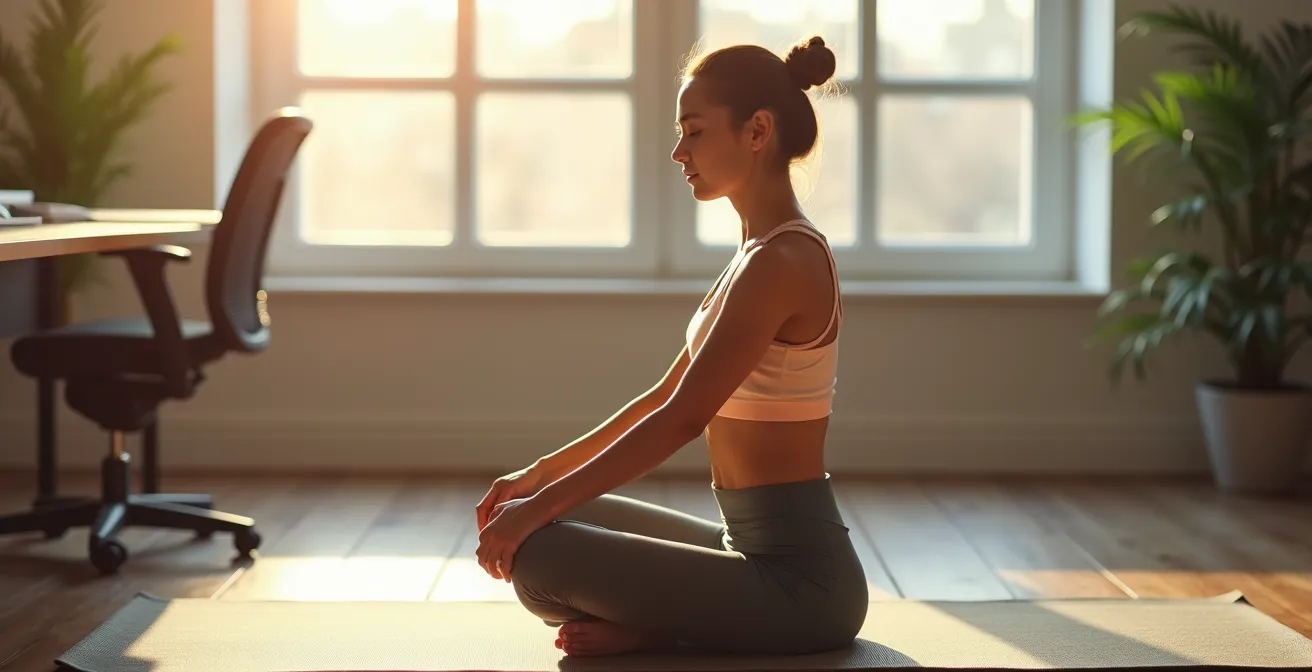
True relief from desk-induced back pain comes not from aggressive stretching, but from rebuilding the neuromuscular control and spinal stability lost to static sitting.
- Gentle, slow-paced yoga (like Hatha) is more effective for rehabilitation than dynamic, fast-flowing styles.
- Consistency is the most critical factor; 20 minutes of daily, targeted movement provides more benefit than a single weekly gym marathon.
Recommendation: Focus on activating and strengthening deep core and gluteal muscles to actively counteract the postural decay caused by a sedentary workday.
The persistent, dull ache in your lower back after a long day at your desk is a familiar sensation for millions. It’s a modern malady born of static posture, where the natural curves of the spine are compromised for hours on end. The common advice is to stretch, to reach for your toes, and to force flexibility into tight hamstrings. Many turn to yoga with this goal in mind, believing that becoming more limber is the ultimate solution to their chronic stiffness and pain.
While well-intentioned, this approach often misses the root cause of the problem. Desk-bound back pain is rarely a simple issue of inflexibility. It’s a complex symptom of what anatomists call “postural decay”—a gradual weakening of the supportive muscles around the spine, a dulling of the body’s spatial awareness (proprioception), and the establishment of dysfunctional movement patterns. Research consistently shows the scale of the issue; one study confirms that 65% of desk workers develop musculoskeletal issues directly related to their work environment.
But what if the key to unlocking a pain-free back isn’t about forcing deeper forward folds, but about re-learning how to move with intelligence and control? This guide re-frames yoga not as a quest for flexibility, but as a therapeutic tool for physical rehabilitation. We will shift the focus from passive stretching to active stability. The goal is not to touch your toes, but to build a resilient, supportive core that can withstand the demands of a sedentary job.
This article will guide you through the anatomical principles of why this approach works. We will explore how to select the right tools and yoga styles, identify common but injurious practices, and establish a sustainable routine that prioritizes neurological re-patterning over impressive-looking poses. It’s time to move beyond the platitudes and address the biomechanics of back pain at its source.
Summary: Using Yoga to Correct Back Pain From All-Day Sitting
- Why You Don’t Need to Touch Your Toes to Benefit From Yoga?
- How to Choose a Yoga Mat That Won’t Slip or Crumble?
- Hatha or Vinyasa: Which Style Suits Beginners Best?
- The “Yoga Butt” Injury caused by Overstretching Hamstrings
- When to Practice Sun Salutations vs Moon Salutations?
- The Squat Mistake That Destroys Knees Over Time
- The Physical Burnout Risk in Trades and How to Plan for It
- Why 20 Minutes of Daily Movement Beats a Weekly Gym Marathon?
Why You Don’t Need to Touch Your Toes to Benefit From Yoga?
The cultural image of yoga is often synonymous with extreme flexibility, epitomized by the ability to touch one’s toes with straight legs. For a desk worker suffering from back pain, this goal is not only intimidating but fundamentally misguided. The root of sitting-induced pain is not a lack of hamstring length; it is the consequence of postural decay, where deep stabilizing muscles become dormant and the brain’s connection to them weakens. The therapeutic value of yoga lies in reversing this decay, not in achieving circus-like flexibility.
The primary benefits for rehabilitating back pain come from three areas that have nothing to do with deep stretching. First is the enhancement of proprioception, or your body’s awareness of its position in space. Gentle, mindful movements retrain your nervous system to sense the alignment of your spine, an ability that atrophies during hours of slumped sitting. Second is the activation of the parasympathetic nervous system—our “rest and digest” mode. Conscious, diaphragmatic breathing down-regulates the body’s stress response, which has a direct effect on lowering pain perception.
Finally, the most crucial element is building an active range of motion. This involves using muscular strength to control your limbs through a pain-free range, rather than using gravity or leverage to force a passive stretch. By focusing on stability and control, you develop strength in the very muscles—like the deep abdominals and glutes—that are designed to support your spine and have been switched off by your chair. This creates a functional, resilient back, whereas chasing passive flexibility can often lead to instability and further injury.
How to Choose a Yoga Mat That Won’t Slip or Crumble?
For a practice focused on rehabilitation and stability, a yoga mat is not just a cushion; it is a critical piece of equipment that provides the foundation for safe movement. An inappropriate mat—one that is too slippery, too thin, or too squishy—can undermine your efforts by forcing compensatory muscle engagement and increasing the risk of injury. The primary qualities to seek in a mat for back pain rehabilitation are grip, density, and appropriate thickness. A non-slip surface is non-negotiable, as it allows you to hold poses without tensing your muscles to prevent sliding, ensuring your effort goes into stabilization, not resistance.
When it comes to thickness, more is not always better. While a very thick mat might feel comfortable for lying down, it can create an unstable surface for standing or balancing poses, compromising your proprioceptive feedback. For protecting the spine and joints without sacrificing stability, physiotherapy experts recommend that a 6mm thickness is the sweet spot. This provides sufficient cushioning for the vertebrae in supine poses without creating the “sinking” feeling that can throw off alignment.
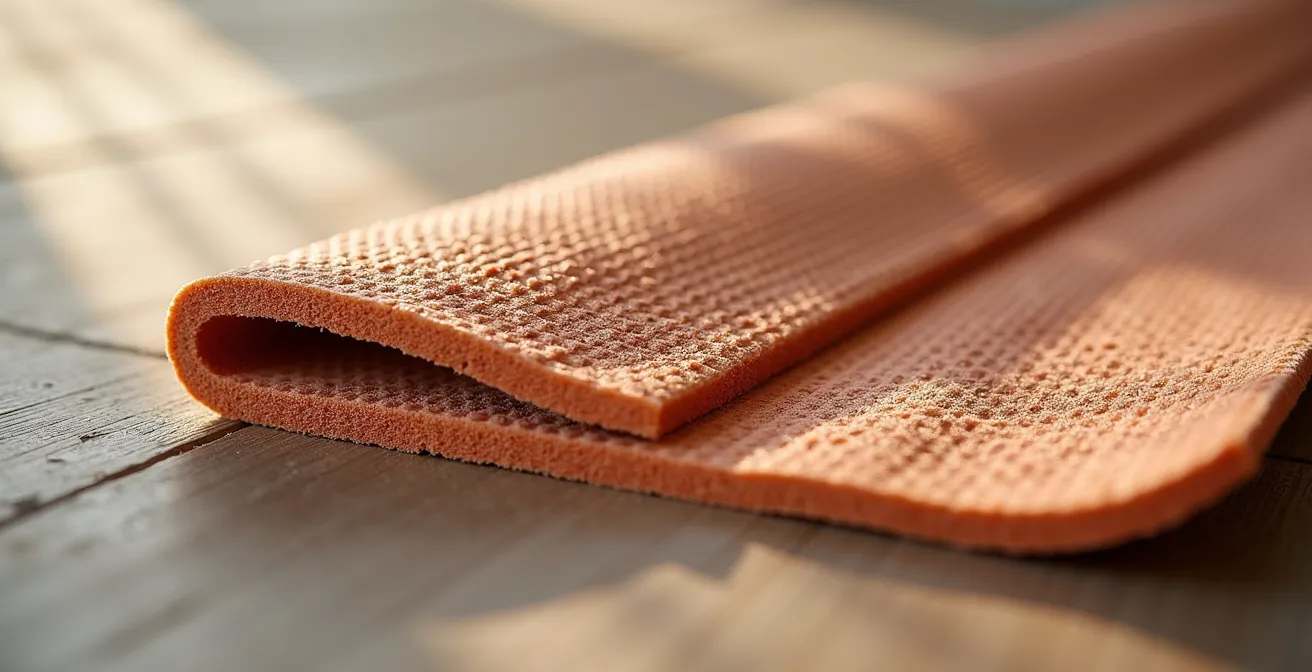
The density of the mat’s material is as important as its thickness. A high-density mat made from natural rubber or high-quality PVC will resist crumbling and provide a solid, grounded feel. A low-density foam mat might compress too easily under pressure, failing to offer reliable support. The following table breaks down how different mat thicknesses serve different purposes, highlighting why a balanced approach is best for therapeutic practice.
| Mat Thickness | Best For | Stability | Cushioning |
|---|---|---|---|
| 3-4mm | Travel, experienced practitioners | High | Low-Moderate |
| 4-5mm | General practice, rehabilitation balance | Good | Moderate |
| 6mm | Back pain relief, joint protection | Moderate | High |
| 8-10mm | Restorative yoga, severe pain | Low | Very High |
Hatha or Vinyasa: Which Style Suits Beginners Best?
Navigating the world of yoga styles can be confusing, but for a desk worker starting yoga for back pain, the choice is critical. The two most common styles offered in studios are Hatha and Vinyasa. While both stem from the same physical tradition, their approach and pacing are vastly different, making one far more suitable for rehabilitation. Vinyasa is characterized by its dynamic, flowing sequences, where movement is synchronized with breath. This can be a vigorous workout, but its fast pace often leaves little room for a beginner to focus on the precise alignment needed to protect an already compromised back.
Hatha, by contrast, is a slower-paced practice where poses are held for several breaths. This extended duration provides an invaluable opportunity to explore the subtleties of alignment, engage the correct stabilizing muscles, and build neuromuscular awareness. It allows you to work within a safe, pain-free range and make micro-adjustments that retrain your body’s posture. This slower, more deliberate approach is strongly supported by scientific research.
Research Spotlight: The Benefits of Slower Yoga for Chronic Pain
A comprehensive review of 12 studies by the University of Maryland School of Medicine, referenced by Consumer Reports, found that people with chronic back pain who practiced gentler forms of yoga (like Hatha) saw small to moderate improvements in back function. The research emphasized that slower-paced styles allowing time to explore alignment were more beneficial for rehabilitation than dynamic practices that might encourage moving too quickly or beyond a safe range.
This evidence aligns with the clinical perspective. As one physical therapy expert noted, the goal is to reverse the damage of sitting. As physical therapy expert Payne states in a Consumer Reports feature:
Sitting too much is the biggest enemy. That position causes people to round forward, which leads to low-back pain. Yoga postures that make the back arch more help to reinstate the natural lumbar curve.
Hatha yoga provides the time and space to safely work on these counter-postures, like gentle backbends, making it the clear choice for a beginner focused on therapeutic outcomes.
The “Yoga Butt” Injury caused by Overstretching Hamstrings
One of the most significant risks in using yoga to address back pain is the misguided focus on aggressively stretching the hamstrings. This can lead to a painful and persistent condition known as proximal hamstring tendinopathy, colloquially nicknamed “yoga butt.” This injury manifests as a deep ache at the very top of the hamstring, right at the ischial tuberosity (the sit bone), and it’s often exacerbated by both sitting and, ironically, hamstring stretches like forward folds.
The mechanism of this injury is directly related to the postural imbalances caused by prolonged sitting. When you sit, your hip flexors become short and tight, while your gluteal muscles become lengthened and weak—a condition often called “gluteal amnesia.” When a person with this imbalance attempts a deep forward fold, their weak glutes cannot effectively stabilize the pelvis. Instead of hinging cleanly at the hips, they often force the stretch from the lower back and place immense strain on the hamstring tendon’s attachment point at the sit bone. The tendon is put under compressive and tensile load, leading to micro-tears, inflammation, and chronic pain.
The belief that “tighter is wronger” and that one must stretch a tight muscle into submission is a dangerous oversimplification. For the desk worker, the hamstrings often feel tight not because they are short, but because they are overworked and chronically held in a lengthened position from sitting. They are, in effect, acting as brakes to prevent the pelvis from tilting too far forward. Aggressively stretching them further only destabilizes the pelvis and irritates the already-stressed tendon attachment. The true solution is not more stretching, but rather strengthening the glutes and core to restore proper pelvic stability and releasing the tight hip flexors.
When to Practice Sun Salutations vs Moon Salutations?
Once you’ve established a safe practice, the timing of your yoga sessions can significantly influence their effectiveness. The yoga tradition offers different sequences designed to have distinct effects on the nervous system. The two most emblematic are Surya Namaskar (Sun Salutation) and Chandra Namaskar (Moon Salutation). Understanding their purpose allows you to strategically integrate movement into your day to counteract the effects of sitting.
Sun Salutations are a dynamic, heating sequence involving forward folds, planks, and gentle backbends like Upward-Facing Dog. Their purpose is to build energy, stimulate circulation, and awaken the body. For a desk worker, a modified and gentle Sun Salutation sequence can be a powerful tool during a mid-day break. It can counteract the afternoon slump, mobilize the spine after hours of stillness, and boost mental clarity. The focus is on generating warmth and controlled movement to reinvigorate a sluggish system.
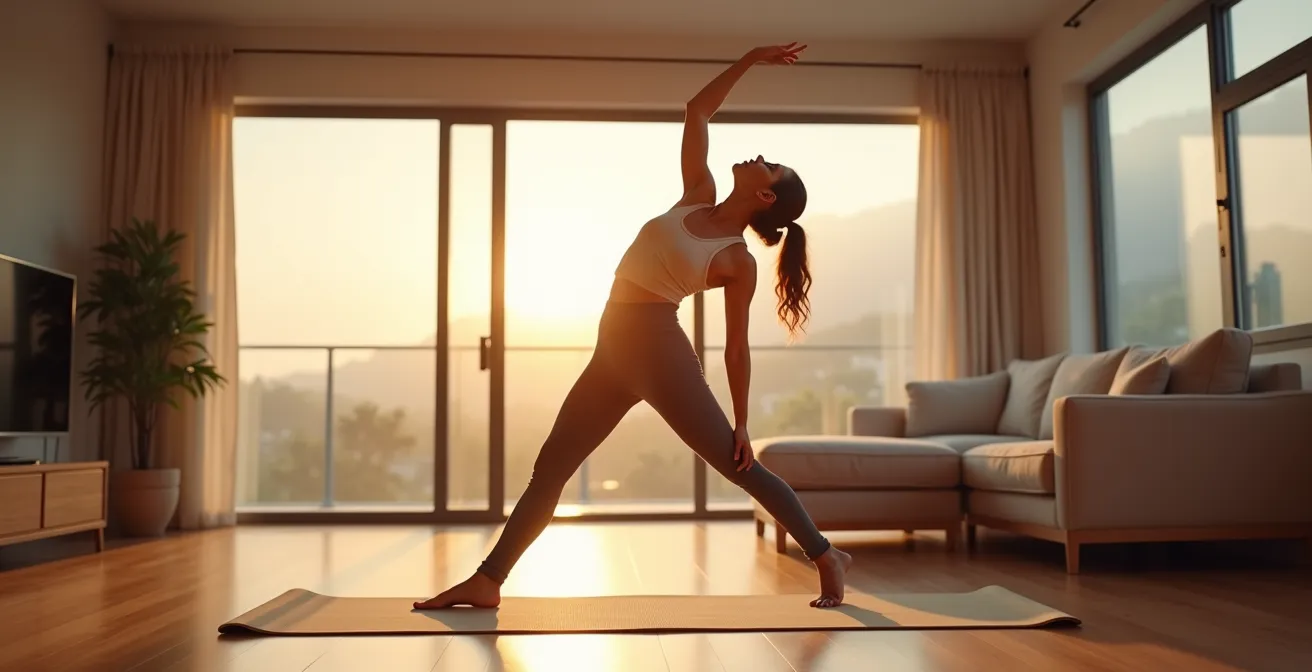
Moon Salutations, in contrast, are a cooling, calming sequence that emphasizes lateral (sideways) stretches and low lunges. They are designed to soothe the nervous system and prepare the body for rest. Practicing a Moon Salutation in the evening after work is an ideal way to decompress. The side bends release tension in the quadratus lumborum (a deep lower back muscle), and the slower, more grounded movements help shift the body out of “work mode” and into a parasympathetic state, promoting better sleep and recovery.
Study on Movement Breaks for Office Workers
The strategic use of different yoga sequences is supported by research into workplace wellness. A study of 193 office workers published in PAIN Reports found that those who took active movement breaks experienced reduced pain. Specifically, workers practicing energizing sequences mid-day reported less fatigue, while those who used calming practices after work showed improved sleep quality and lower pain levels the next day. This underscores the value of tailoring your practice to the time of day.
The Squat Mistake That Destroys Knees Over Time
A functional squat is one of the most important movements for human health, essential for building the glute and leg strength needed to support the spine. However, years of sitting in chairs teach us a dysfunctional movement pattern that, when brought into a squat, can lead to knee and back pain. The common mistake is initiating the squat by breaking at the knees and shifting weight forward onto the toes. This is a quad-dominant movement that places immense shearing force on the knee joint and fails to engage the powerful posterior chain (glutes and hamstrings).
The correct, “hip-dominant” squat pattern involves initiating the movement by sending the hips back first, as if sitting into an invisible chair far behind you. The weight should remain in the heels, the chest stays lifted, and the knees track over the ankles, never extending past the toes. This pattern engages the glutes to control the descent and power the ascent, taking the strain off the knee ligaments and protecting the lumbar spine by maintaining a neutral curve.
In yoga, the perfect pose to re-learn this fundamental pattern is Utkatasana, or Chair Pose. It forces you to adopt a hip-hinge pattern and actively engage the posterior chain and core to hold the position. Practicing it correctly is a direct antidote to the postural habits of sitting. It strengthens the exact muscles that have become weak and re-patterns a movement that is crucial for daily activities like lifting or simply getting up from a chair without straining your back.
Action Plan: Correcting Your Squat with Chair Pose
- Foundation First: Start in a standing position with your feet hip-width apart. Ground your weight firmly into your heels, feeling the connection with the floor.
- Core Engagement: Before moving, draw your navel gently toward your spine. This engages your deep core muscles to maintain a neutral, supported spine throughout the pose.
- Initiate with the Hips: Begin the movement by sending your hips backward, as if reaching to sit in a chair that is far behind you. Your knees will bend naturally, but they must stay behind your toes.
- Hold and Activate: Lower until your thighs are as parallel to the floor as you can manage without pain or losing form. Hold for 30 seconds, actively squeezing your glutes and focusing on this activation rather than tensing your quads.
- Controlled Rise: To come up, press firmly through your heels and use your glutes to drive your hips forward and up, maintaining core engagement to protect your lower back.
Key Takeaways
- The goal of yoga for back pain is to build active stability and neuromuscular control, not passive flexibility.
- For beginners in rehabilitation, a slow-paced Hatha practice is safer and more effective than a fast-paced Vinyasa flow.
- Consistent, short daily practices are superior to infrequent, intense sessions for re-patterning movement and reducing chronic pain.
The Physical Burnout Risk in Trades and How to Plan for It
The term “physical burnout” is typically associated with manual trades—professions involving heavy lifting, repetitive motion, and the risk of acute injury. A construction worker or a mechanic understands this risk as part of their job. However, the desk worker faces their own insidious form of physical burnout, one that is not caused by excessive load but by the absence of it. This is the burnout of static load decay, where the body’s structures degrade due to prolonged immobility.
While a tradesperson’s risk comes from acute, high-impact forces, a desk worker’s risk accumulates gradually from the low-grade, constant force of sitting. This static posture leads to muscle atrophy, joint stiffness, and metabolic decline. The pain develops not from a single event, but from the slow accumulation of thousands of hours spent in a compromised position. Recovery for a tradesperson often involves rest and repair. For the desk worker, the solution is the opposite: targeted movement and muscular activation to counteract the decay.
Yoga, when applied therapeutically, serves as a long-term plan to prevent this unique form of burnout. It is not simply exercise; it is a system of maintenance for the body’s structural integrity. By systematically moving the spine through its full range of motion, activating dormant muscles, and improving circulation, you are actively planning against the inevitable physical decline that a sedentary career can cause. Viewing your daily yoga practice as a non-negotiable part of your professional development—as crucial as any other skill—is the key to a long, pain-free career at your desk.
The following table, based on principles from workplace health analyses like those from the CDC’s NIOSH division, contrasts these two forms of physical risk to highlight the unique challenge faced by desk workers.
| Factor | Physical Trades | Desk Work |
|---|---|---|
| Primary Risk | Acute load injuries | Static load decay |
| Main Issues | Heavy lifting, repetitive motion | Prolonged sitting, muscle atrophy |
| Pain Development | Sudden onset | Gradual accumulation |
| Recovery Need | Rest and repair | Movement and activation |
| Prevention Focus | Proper lifting technique | Regular movement breaks |
Why 20 Minutes of Daily Movement Beats a Weekly Gym Marathon?
In our culture of extremes, it’s common to believe that more is better. For fitness, this often translates into the “weekend warrior” syndrome: sedentary all week, followed by an intense, hour-long gym session or yoga class. While this might feel productive, for rehabilitating chronic back pain, this approach is often ineffective and can even be counterproductive. The body, especially one conditioned by static sitting, adapts to consistency, not intensity.
Chronic back pain from sitting is a problem of neurological patterning. Your brain and muscles have “learned” a dysfunctional posture. The goal of therapeutic movement is to unlearn this pattern and replace it with a healthy one. This requires frequent, consistent input. A 20-minute daily practice provides the nervous system with a regular, repeated signal to activate the core, engage the glutes, and maintain a neutral spine. This daily reinforcement is far more powerful for creating lasting change than a single, overwhelming weekly session from which the body simply returns to its old habits for the next six days.
Furthermore, an intense weekly session on a deconditioned body increases the risk of strain and injury. It asks muscles that are dormant most of the week to suddenly perform at a high level. A shorter, daily practice keeps these muscles “awake” and responsive, building resilience gradually and safely. It’s not about exhausting yourself; it’s about consistently reminding your body how to support itself correctly. This small, daily investment in mindful movement is the most effective strategy for dismantling the patterns of pain established by years of sitting and building a foundation of strength that lasts.
Begin integrating these targeted movements into your daily routine to actively reverse the effects of static sitting and build a more resilient spine.